Leadership

The Remote Product Leader's Playbook: Building Adaptive Teams Across Distance

Remote product leadership isn't just about managing teams from a distance. It's about fundamentally reimagining how breakthrough innovation happens when your most important collaborators are scattered across continents and time zones.

By Adaptable Product 10 min read
Remote Product Leadership and Distributed Teams
Executive Summary

The traditional playbook for product leadership breaks down when you can't read body language in hallway conversations or build trust through shared coffee breaks. Yet the most successful remote product leaders don't just overcome these limitations, they transform them into competitive advantages. Remote product leadership requires intentional systems for empowerment, psychological safety, and collective intelligence that most in-person teams never develop. When done right, distributed teams can achieve breakthrough results that exceed their co-located counterparts.

When Cultural Distance Became My Greatest Teacher

I learned this lesson the hard way while managing development teams across three continents. From the beginning, I realized that cultural differences between teams would be our biggest challenge, but I had no idea how much it would reshape my understanding of leadership itself.

My team in Southeast Asia came from a culture where hierarchy and respect for authority were fundamental values. Initially, I interpreted their quiet agreement with my suggestions as alignment, but our execution kept falling short. They weren't sharing ideas, pitching alternatives, or taking ownership over the development process. They were simply doing exactly what I asked, nothing more. They didn't realize they had 'permission' to push back on my ideas or suggest improvements.

Meanwhile, halfway around the world, I had a team from an extremely egalitarian culture where questioning authority was not just acceptable but expected. Every suggestion I made was met with immediate pushback and heated debate. Initially, I found myself getting defensive and frustrated, thinking they were trying to undermine my leadership.

The breakthrough came when I realized that in both cases, the teams were actually trying to help me succeed, but they were expressing it in completely different ways.

The quiet team's silence after I made suggestions wasn't agreement, it was a sign that there was a problem I was missing. The argumentative team's heated debates weren't attempts to derail my ideas, they were actually signs of engagement and careful thinking about implementation challenges.

This realization forced me to develop new systems for reading virtual body language, building relationships across cultural contexts, and creating structured ways for different communication styles to contribute to our collective intelligence. The results were transformative. Within six months, our distributed team was generating more innovative solutions and making better decisions than any co-located team I had ever managed.

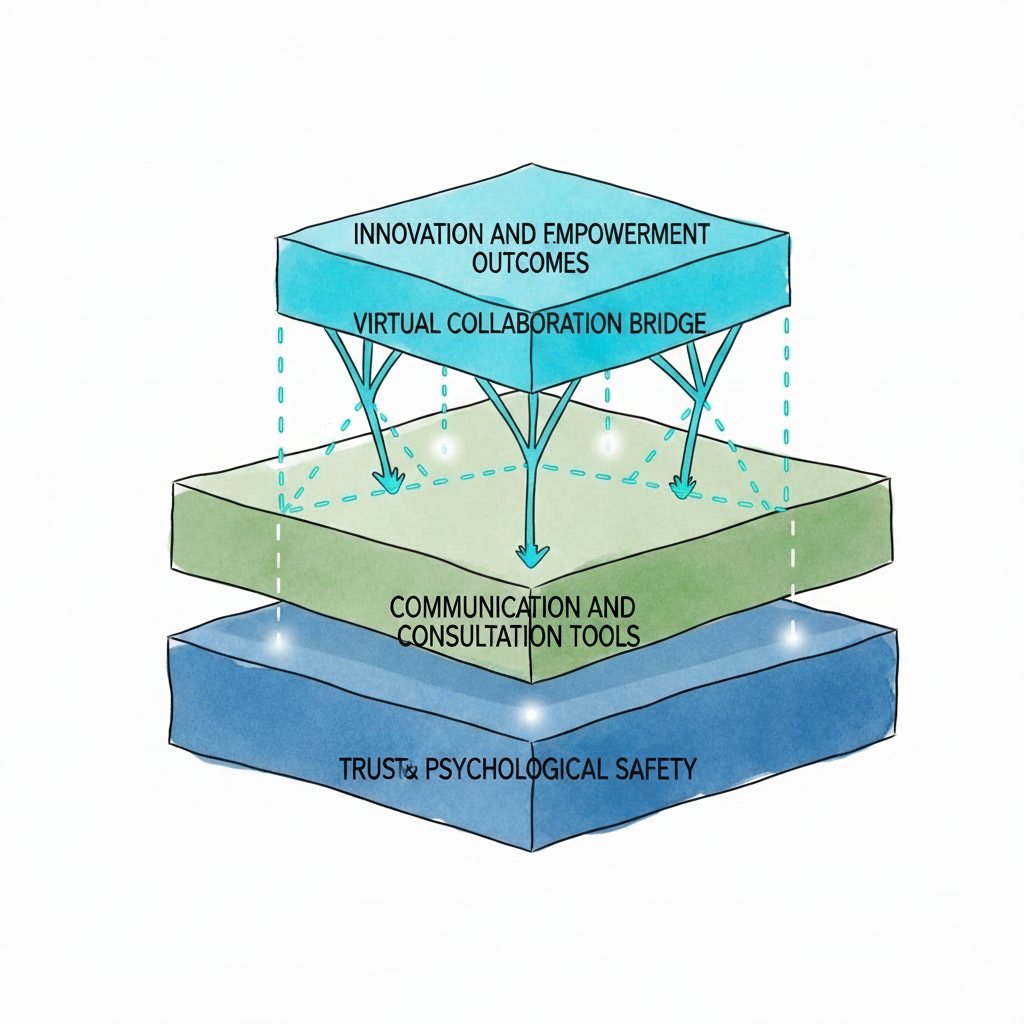
The Three Pillars of Remote Product Leadership Excellence

1. Virtual Psychological Safety Foundation

Creating psychological safety remotely requires systematic, intentional effort because the normal social cues that build trust are completely absent. The most successful remote product teams don't just adapt to this challenge, they create stronger safety nets than most in-person teams ever achieve.

Weekly Connection Before Content Check-ins: Start every team meeting with structured personal sharing that goes beyond "how was your weekend?" Create rotating prompts that help team members share professional challenges, learning experiences, or even personal context that affects their work. This builds the human connection that makes challenging conversations possible.

Safe Failure Sharing Rituals: Implement monthly retrospectives sessions where team members share mistakes, near-misses, and failed experiments along with wins and compliments. Make these celebrations of learning rather than blame sessions. Document the insights and refer back to them regularly to reinforce that failure is part of innovation.

Clear Communication Norms: Establish explicit agreements about how different working styles and time zones will be respected. This includes protocols for when to use synchronous vs. asynchronous communication, how to handle urgent vs. non-urgent decisions, and how to ensure everyone's voice is heard despite different communication preferences.

2. Asynchronous Consultation Systems

Traditional decision-making processes assume everyone is available at the same time. The best remote product teams design decision-making processes that actually improve over time through their distributed nature.

Structured Decision Documentation: Create templates that capture not just what decisions were made, but the context, alternatives considered, and reasoning behind the choice. This "consultation trail" becomes invaluable for onboarding new team members and for revisiting decisions as circumstances change. It also ensures that those who want to push back or who have different perspectives will have space to do that.

Time Zone Advantage Processes: Instead of seeing different time zones as obstacles, design processes that use them as advantages. Have your European team analyze user feedback overnight so your American team can start the day with insights. Have your Asian team prototype solutions that your European team can iterate on the next day.

Collaborative Intelligence Amplification: Implement structured brainstorming and problem-solving processes that harness the diversity of thought that distributed teams naturally create. Use methods like asynchronous brainwriting, structured debate processes, and rotating perspective-taking exercises.

Remote team collaboration and virtual leadership

3. Remote Empowerment Practices

Clear Authority Boundaries: Create explicit frameworks that define what decisions team members should make autonomously, what requires consultation, and what needs formal approval. Update these boundaries regularly as team members grow and prove their judgment. Revisit them in your retrospectives.

Virtual Mentorship Systems: Pair team members across different time zones and expertise areas. Structure these relationships with regular check-ins, shared project work, and mutual learning goals. This creates multiple pathways for professional development and knowledge sharing.

Empowerment Check-ins: Regular one-on-one conversations focused specifically on whether team members feel supported, autonomous, and capable of making the decisions they need to make. These aren't performance reviews, they're calibration sessions for ensuring empowerment is actually working.

The Evidence: Why Systematic Remote Leadership Works

Recent research validates what the best remote product leaders have discovered through experience. Buffer's 2024 State of Remote Work found that 89% of remote product teams report challenges with alignment and empowerment, while teams with structured remote leadership practices achieve 67% better outcomes than those using ad hoc approaches.

MIT's Remote Collaboration Study revealed that distributed teams with systematic trust-building and consultation processes generate 45% more innovative solutions and report 78% higher psychological safety scores compared to traditional remote management approaches.

Perhaps most compelling, Harvard Business School's Remote Leadership Research showed that organizations with adaptive remote product leadership see 23% faster decision-making and 34% higher employee engagement compared to traditional remote management approaches.

As Amy Edmondson from Harvard Business School notes, "Psychological safety is even more critical in remote environments because the normal social cues that build trust are absent. It requires intentional, systematic effort."

The key insight from Priya Parker, author of "The Art of Gathering," resonates strongly: "Remote collaboration isn't about replicating in-person meetings online. It's about reimagining how human connection and collective intelligence happen across distance."

Your 30-Day Remote Leadership Transformation

Week 1: Assessment and Foundation

  • Audit your current decision-making processes to identify bottlenecks where remote work is creating delays
  • Implement daily connection-before-content check-ins in all team meetings
  • Create your first consultation trail documentation template

Week 2: Systematic Safety Building

  • Launch periodic retrospective sessions with your team where you review what happened, what went well, what did not go well, and what you can do for the future
  • Establish clear communication norms that account for different time zones and working styles
  • Begin tracking psychological safety through regular pulse surveys

Week 3: Empowerment Framework Implementation

  • Map decision authority boundaries with each team member
  • Set up cross-timezone mentorship partnerships
  • Create structured empowerment check-in processes

Week 4: Optimization and Scaling

  • Analyze which remote processes are working best and which need adjustment
  • Begin training other leaders in your organization on these systematic approaches
  • Document your learnings to build institutional knowledge

The Distributed Advantage

The most successful remote product leaders understand that distributed teams aren't just remote teams that work well, they're teams that harness unique advantages that co-located teams simply can't access. When you can't rely on proximity and informal communication, you're forced to build better systems. When you can't read everyone's body language, you develop better listening skills. When you can't make quick hallway decisions, you create better decision-making frameworks.

The result isn't just teams that work well remotely. It's teams that think more clearly, decide more wisely, and innovate more systematically than most in-person teams ever achieve.

Ready to transform your remote product leadership? The Adaptable Product Framework provides the systematic tools and processes you need to build high-performing distributed teams that don't just survive the challenges of remote work but thrive because of them.

Key Takeaways:
  • Remote product leadership requires intentional systems for psychological safety and empowerment that exceed most in-person teams
  • Cultural differences in remote teams become competitive advantages when properly channeled through structured consultation
  • The three pillars: Virtual Psychological Safety, Asynchronous Consultation Systems, and Remote Empowerment Practices
  • Time zones can be advantages when you design processes that leverage distributed work cycles
  • Start with connection-before-content check-ins and build systematic decision documentation immediately

Ready to Build High-Performing Remote Product Teams?

Explore our Adaptable Product Framework course to learn systematic approaches for remote leadership, psychological safety, and distributed decision-making that transform uncertainty into competitive advantage.

Related Articles

Leadership
The Empowerment Paradox: Why Giving Control Actually Increases Your Influence

Most product leaders believe that maintaining tight control over decisions, processes, and outcomes is necessary for achieving results and demonstrating their value.

12 min read Read More
Framework
The Consultation Revolution: Transforming Product Meetings from Status Updates to Strategic Decisions

If you're like most product managers, you spend 60-80% of your time in meetings that feel like productivity black holes.

11 min read Read More
Innovation
Building a Learning Community: Leveraging Collective Intelligence for Innovation

I took over a data science team building advanced scoring models for content assessment. We were on the 7th iteration of our regression model, which had actually decreased its ability to correctly score documents.

12 min read Read More