Leadership

The Empowerment Paradox: Why Giving Away Control Actually Increases Your Influence

The highest-performing product leaders understand a counterintuitive truth: the more control you give away strategically, the more influence you actually gain. Empowered teams don't just execute better, they innovate faster and create results that no individual leader could achieve through control alone.

By Adaptable Product • 12 min read
Strategic Empowerment and Leadership Influence
Executive Summary

Most product leaders believe that maintaining tight control over decisions, processes, and outcomes is necessary for achieving results and demonstrating their value. This command-and-control mindset is actually the biggest obstacle to their success and influence. When you empower team members with genuine authority, ownership, and stake in success, you don't become less important. You become exponentially more effective because your impact multiplies through every person you empower. This isn't about abdication or loose oversight—it's about systematic empowerment that creates distributed decision-making capabilities and generates results that no individual leader could achieve through control alone.

When I Stopped Leading and Started Empowering

I learned this lesson while heading up a profitable PC device portal product that had been stable for several years. Having just come from a similar industry that was churning through mobile and tablet viewing trends, I could see the writing on the wall. We needed to revamp our product for mobile devices before these trends negatively affected our business.

My first instinct was to use my experience to lead the change. I had seen this transition before, I understood the technical challenges, and I knew what needed to happen. But as I started developing the strategy, I realized that dictating the new product direction would create exactly the wrong kind of organizational dynamic.

If I wanted to convince leadership to invest in a significant product revamp, I needed more than a good plan. I needed organizational energy, cross-team commitment, and genuine enthusiasm for the change. Instead of giving direction, I decided to give my teams a challenge and let them come up with the suggested direction.

I brought together experts from across the company: the UX leader, the engineering leader, the sales leader, and others. Instead of presenting my solution, I presented the problem.

I shared the market data, explained the competitive threats, and asked them to dig into the mobile challenges and marketplace impacts themselves.

What happened next was transformative. Each leader took ownership of different aspects of the challenge. They started researching, innovating, and pitching new directions. Instead of trying to control the change process, I let the content team, design team, and tech teams experiment, try new things, and make the mistakes we needed to make to learn what we needed to learn.

The results exceeded my expectations in two crucial ways. First, the new direction we collectively developed was significantly better than what I would have suggested on my own. The distributed expertise and diverse perspectives created solutions I never would have imagined.

Second, by empowering team members to take ownership over the future of the product with me, we all had a vested interest in seeing it succeed. When we presented the initiative to leadership, they didn't just see a product proposal. They saw a cross-team initiative with tremendous support and energy. The project was approved with enthusiasm and adequate resources.

By giving away control over the solution, I had gained far more influence over the outcome than I could have achieved through traditional leadership approaches.

Empowerment Framework and Influence Multiplication

The Three Pillars of Strategic Empowerment

1. Decision Authority Mapping and Distribution

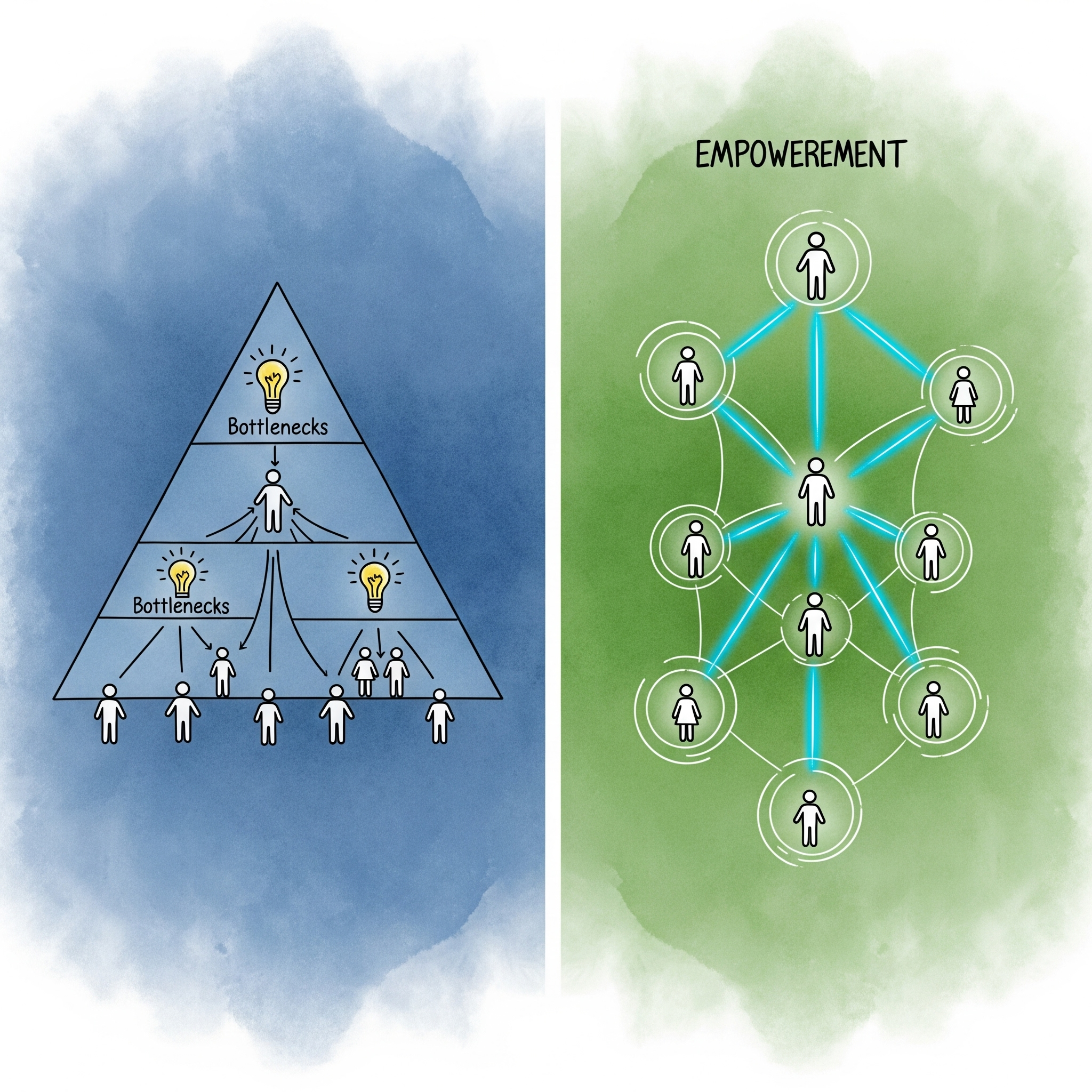
Most product leaders are decision-making bottlenecks without realizing it. Every choice that flows through you slows down the organization and limits your team's growth potential.

Comprehensive Decision Audit: Identify every decision that currently requires your input or approval. Categorize these decisions by impact level (high, medium, low) and expertise requirements (strategic knowledge, technical knowledge, customer knowledge, operational knowledge).

Strategic Delegation Framework: Systematically redistribute decision authority based on expertise and impact. High-impact strategic decisions may stay with you, but medium and low-impact decisions should flow to team members who have the relevant expertise and context.

Clear Authority Boundaries: Create explicit frameworks that define what decisions team members can make autonomously, what requires consultation, and what needs formal approval. The goal isn't to eliminate your involvement but to ensure your time focuses on decisions where your unique perspective adds the most value.

Success Metrics and Accountability: Establish clear success metrics for each delegated decision area and create accountability systems that support autonomous decision-making while maintaining alignment with organizational goals.

2. Empowerment Framework Implementation

True empowerment requires systematic support structures that help team members succeed with their new authority and responsibility.

Decision-Making Frameworks: Provide team members with structured approaches for making good decisions in their areas of authority. This includes criteria for evaluation, stakeholder consultation processes, and risk assessment frameworks.

Regular Coaching Conversations: Schedule consistent one-on-one coaching focused on helping team members develop their decision-making capabilities, navigate challenges, and grow into expanded roles. These conversations should focus on their growth and success, not your control. Drive the discussions with questions, rather than lecturing.

Failure Tolerance Policies: Create explicit policies that make it safe for team members to make mistakes while learning. Define what constitutes acceptable failure versus unacceptable failure, and ensure people understand they won't be punished for good-faith efforts that don't work out. Identify options that are one-way vs. two-way options. One-way options cannot be recovered easily and should be decided more carefully. Two-way options can switch to an alternative relatively easily and should be given more autonomy.

Recognition and Celebration Systems: Implement systems that regularly recognize and celebrate autonomous successes. When team members make good decisions independently, make sure they get credit publicly. This reinforces the empowerment culture and encourages others to take initiative.

3. Influence Amplification Systems

The most empowering leaders build systems that multiply their impact through every person they develop.

Mentorship Program Development: Create structured mentorship relationships that help team members develop both tactical skills and strategic thinking capabilities. Your influence multiplies when the people you develop become mentors themselves.

Knowledge Sharing Platforms: Build systems that capture and share decision-making context, lessons learned, and best practices across the team. This creates organizational intelligence that scales beyond any individual's knowledge. Explore using AI to write up case studies based on the detailed project artifacts you created to save time.

Decision Documentation Processes: Implement processes that document not just what decisions were made, but the reasoning, alternatives considered, and lessons learned. This creates institutional knowledge that empowers future decision-making.

Feedback Loop Systems: Create mechanisms that help you understand how your empowerment efforts are working, where team members need additional support, and how to continuously improve your empowerment approaches.

The Evidence: Why Empowerment Creates Better Results

Research consistently validates the superiority of empowerment-based leadership approaches. MIT's Leadership Study found that product leaders using empowerment-based approaches achieve 67% greater team performance and 45% higher innovation rates while reporting 23% less stress and burnout.

Harvard Business School's Authority Research revealed that teams with distributed decision-making authority make decisions 78% faster and achieve 56% better outcomes compared to centralized control structures.

Gallup's Engagement Research showed that empowered product teams demonstrate 89% higher engagement scores, 67% lower turnover rates, and 34% better customer satisfaction results.

As Susan Wojcicki, former YouTube CEO, explains: "The best product leaders don't create followers; they create other leaders. That happens through genuine empowerment, not just delegation."

Andy Grove, former Intel CEO, adds crucial perspective: "The art of management is to give people the context and tools they need to make good decisions, then get out of their way. That's how you scale impact."

Kim Scott, author of "Radical Candor," reinforces the key insight: "True authority comes from empowering others to be their best selves, not from controlling their every move. Empowered teams make leaders more influential, not less."

Your 90-Day Empowerment Transformation

Days 1-30: Decision Authority Assessment

  • Audit all decisions that currently flow through you
  • Categorize decisions by impact level and expertise requirements
  • Identify 3-5 decision areas ready for immediate delegation
  • Have initial conversations with team members about expanded authority

Days 31-60: Framework Implementation

  • Create decision-making frameworks for delegated areas
  • Establish coaching conversation rhythms with empowered team members
  • Implement failure tolerance policies and recognition systems
  • Begin documenting decision outcomes and lessons learned

Days 61-90: Systems and Scale

  • Build knowledge sharing platforms and mentorship programs
  • Evaluate empowerment effectiveness and adjust approaches
  • Identify additional decision areas for delegation
  • Train team members to become empowerment leaders themselves

Beyond Control: Building Multiplied Influence

The most profound insight about empowerment isn't that it makes teams perform better, though it does. It's that empowerment fundamentally changes your role from decision-maker to decision-enabling strategist. Instead of being limited by your own capacity, you become limited only by your ability to develop others.

The leaders who master systematic empowerment don't just build better teams, they build organizations that can adapt, innovate, and scale far beyond what any individual leader could achieve through control. Your influence doesn't diminish when you empower others. It multiplies through every person who grows under your leadership.

Key Takeaways:
  • Strategic empowerment increases influence by multiplying impact through every person you develop
  • Most product leaders are unconscious decision-making bottlenecks that slow organizational growth
  • The three pillars: Decision Authority Mapping, Empowerment Framework Implementation, and Influence Amplification Systems
  • Empowered teams achieve 67% greater performance and 45% higher innovation while making decisions 78% faster
  • Start with decision audits, create coaching rhythms, and build failure tolerance policies immediately

Ready to Transform Your Leadership Through Empowerment?

Explore our Adaptable Product Framework course that provides systematic tools for decision authority mapping, empowerment framework implementation, and influence amplification systems.

Related Articles

Leadership
The Remote Product Leader's Playbook: Building Adaptive Teams Across Distance

The traditional playbook for product leadership breaks down when you can't read body language in hallway conversations or build trust through shared coffee breaks.

10 min read Read More
Career Growth
Building Your Product Career Moat: Skills That AI Can't Replace

AI can already write better product requirements documents than most PMs, analyze user data faster, and create detailed project plans.

13 min read Read More
Innovation
Building a Learning Community: Leveraging Collective Intelligence for Innovation

I took over a data science team building advanced scoring models for content assessment. We were on the 7th iteration of our regression model, which had actually decreased its ability to correctly score documents.

12 min read Read More