Career Growth

Building Your Product Career Moat: Skills That Will Matter in Five Years

The product management job you have today won't exist in five years. Not because the role is disappearing, but because everything that makes you valuable as a product manager is changing dramatically.

By Adaptable Product 13 min read
Future-Proof Product Management Skills and Career Development
Executive Summary

AI can already write better product requirements documents than most PMs, analyze user data faster, and create detailed project plans. The tactical skills that got you hired are rapidly becoming commodities. Yet while many product managers panic about AI taking their jobs, the smartest ones recognize an unprecedented opportunity. As routine cognitive work gets automated, the premium shifts to uniquely human capabilities: strategic foresight in uncertain environments, empowerment of diverse teams, community building across complex stakeholder networks, and consultation skills that turn conflicting perspectives into breakthrough decisions.

When Templates Became My Career Trap

When I first became a product manager during the dot-com boom, the field was still relatively new. Everyone joked that every barista was becoming a PM, but I felt well qualified and excited for the opportunity. I had achieved both business and technology degrees, plus internships and school projects in entrepreneurship that prepared me to navigate between engineering, design, finance, support, sales, legal, and customer teams.

As I learned on the job, I threw myself into mastering the craft. I read every product management book I could find. I took certificate programs in UX design and web application development. Most importantly, I built an extensive collection of templates and starter guides that could handle nearly any request: Product Requirements Documents, technical specifications, database schemas, user research studies, press releases, Agile epics and stories, Jobs-to-be-Done analyses. I was ready for anything, or so I thought.

But as I progressed in my career, I started to realize that having the best documentation wasn't solving our biggest problem. Providing quality paperwork wasn't enough. Things were changing every few years, requiring completely new approaches to products, services, technologies, form factors, and user interactions. Regulations were reshaping entire industries. Innovations were enabling entirely new business models.

I didn't want my job to be just documenting a steady stream of feature requests in one direction. If I really wanted to help the business adapt to a changing world, I needed fundamentally different capabilities.

This is when I started studying innovation management, creativity management, and change management. I began developing skills in organizational awareness that would let me not just suggest great new features, but pitch entirely new business models, completely different operational approaches, and fresh ways to plan strategy and tactics.

The revelation was profound: as PMs, we have the potential to help companies change course and plot new directions. But it's only potential. Leaders don't know what they don't know. They don't realize they can ask PMs to do scenario analysis, empowerment consulting, or strategic facilitation.

That's when I understood that the real career opportunity wasn't in getting better at traditional PM tasks. It was in learning how to earn the authority to anticipate, plan for, and maybe even save companies from the big changes coming their way.
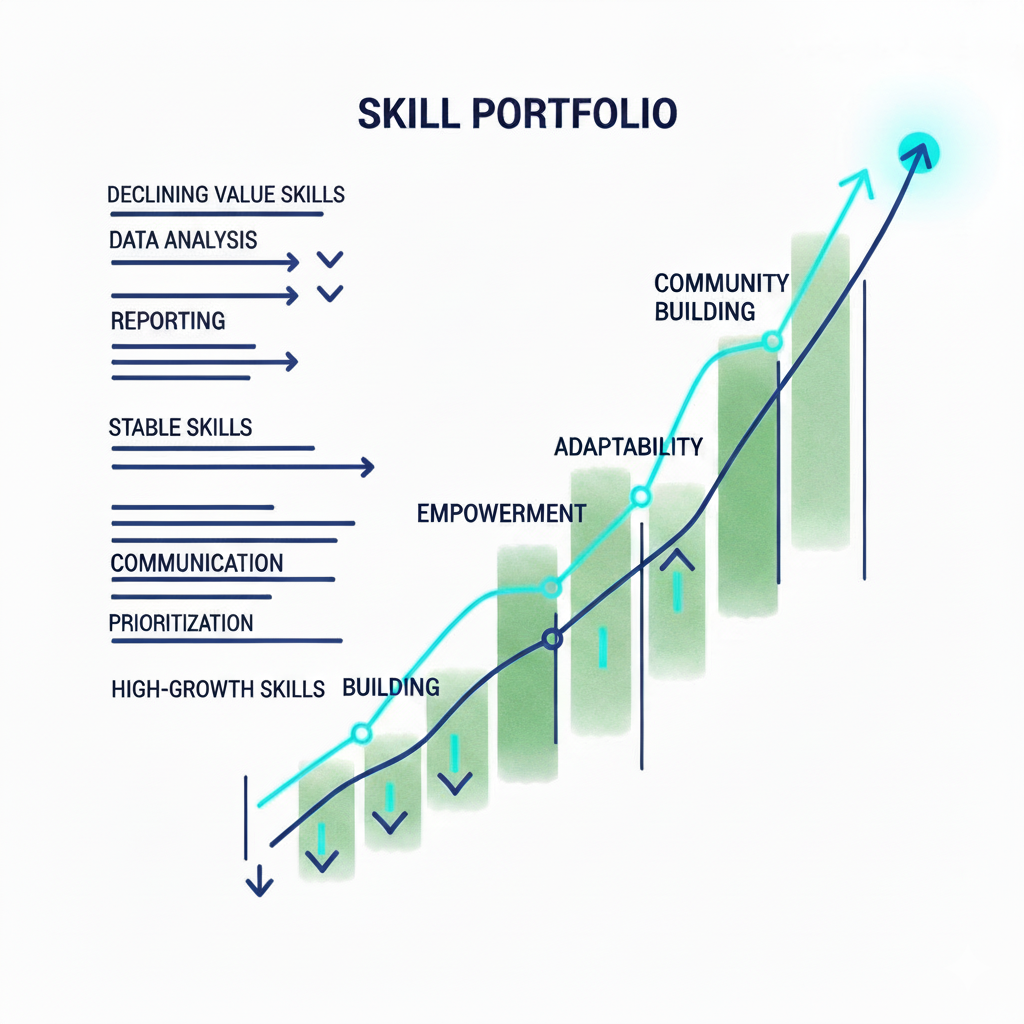
Future-Focused Product Management Capabilities and Skills Framework

The Four Pillars of Future-Proof Product Management

1. Adaptability and Strategic Foresight

While AI excels at analyzing historical data, it struggles with the kind of strategic foresight that navigates unprecedented situations and emerging uncertainties.

Scenario Planning Mastery: Develop systematic approaches to identifying trends, drafting multiple possible futures, and building strategies that work across different outcomes. This isn't just planning for known risks, it's preparing for unknown unknowns.

Pattern Recognition Across Industries: Cultivate the ability to see how innovations in one industry create opportunities or threats in completely different sectors. The PM who can spot how blockchain developments affect supply chain management or how social media trends impact healthcare delivery becomes invaluable.

Uncertainty Navigation: Build comfort with ambiguous situations and develop frameworks for making high-quality decisions with incomplete information. This includes knowing when to gather more data versus when to move forward with current knowledge.

2. Empowerment and Team Development

The most valuable PMs in the next five years won't be those who make the best decisions, but those who help others make better decisions than they ever could alone.

Coaching and Mentorship: Develop systematic approaches to helping team members grow their capabilities, take on greater responsibility, and become autonomous decision-makers. This multiplies your impact far beyond what you could achieve individually.

Psychological Safety Creation: Master the skills needed to create environments where people feel safe to share ideas, admit mistakes, and challenge assumptions. This becomes especially critical in remote and diverse team environments.

Authority Distribution: Learn how to strategically delegate decision-making authority to team members while maintaining accountability and alignment. The goal is empowering others to make better decisions faster, not maintaining control.

3. Community Building and Network Effects

As products become increasingly connected and ecosystem-dependent, the ability to build and nurture communities becomes a core competitive advantage.

Stakeholder Ecosystem Mapping: Develop sophisticated understanding of all the people and organizations that affect or are affected by your product decisions. This includes customers, partners, regulators, competitors, and internal stakeholders.

Cross-Functional Coalition Building: Master the art of building alliances across different departments, time zones, and organizational priorities. The PM who can align engineering, sales, marketing, and leadership around shared goals becomes indispensable.

External Network Cultivation: Build relationships with customers, industry experts, partners, and peers that create information advantages and collaboration opportunities that benefit your organization.

4. Consultation and Facilitation

The future belongs to PMs who can turn conflicting perspectives into breakthrough decisions through systematic consultation processes.

Meeting Transformation: Develop the ability to turn any gathering into a high-value decision-making session through structured problem framing, inclusive input gathering, and systematic analysis.

Conflict Resolution: Master techniques for navigating disagreements constructively, finding common ground across different perspectives, and building consensus around difficult decisions.

Collective Intelligence Facilitation: Learn how to harness the distributed knowledge and creativity of diverse teams to generate solutions that no individual could develop alone.

The Evidence: Why Future-Focused Skills Command Premium Value

The data strongly supports focusing on these future-focused capabilities. The World Economic Forum's Future of Jobs Report found that 58% of current product management tasks will be automated by 2030, while demand for strategic thinking, empowerment, and community building skills will increase by 73%.

McKinsey Global Institute's Skills Research revealed that product managers with strong adaptability and empowerment skills command 34% higher salaries and experience 67% faster career progression compared to those focused primarily on tactical capabilities.

LinkedIn's Career Skills Analysis showed that job postings for senior product roles increasingly emphasize "strategic foresight" (156% increase), "team empowerment" (134% increase), and "community building" (178% increase) over traditional analytical skills.

As Cal Newport, author of "Digital Minimalism," explains: "In an age of automation, your career security comes from developing skills that are hard to replicate and high in value." For product managers, that's increasingly about human connection and strategic judgment.

Susan David from Harvard adds crucial perspective: "The future belongs to those who can navigate uncertainty, empower others, and build authentic connections. These are fundamentally human capabilities that no algorithm can replicate."

Your 18-Month Career Transformation Plan

Months 1-3: Skill Audit and Future Mapping

  • Assess your current skill portfolio across tactical, strategic, and human capabilities
  • Map each skill's likely automation risk and future market value
  • Identify the biggest gaps in your future-focused capabilities

Months 4-9: Strategic Skill Development

  • Begin systematic practice of scenario planning for your product area
  • Take on team development projects that require empowerment skills
  • Start building internal and external networks through community involvement

Months 10-15: Application and Validation

  • Seek roles and projects that demonstrate your future-focused capabilities
  • Build a portfolio of empowerment and community building successes
  • Begin positioning yourself as a strategic advisor rather than just a task executor

Months 16-18: Career Positioning and Market Testing

  • Pursue opportunities that require advanced consultation and facilitation skills
  • Reassess your progress and adjust strategy based on market feedback
  • Begin mentoring others to solidify your reputation as a leader in future-focused PM capabilities

Beyond Automation: Building Irreplaceable Value

The most important insight about building a career moat isn't that certain skills won't be automated. It's that the combination of strategic foresight, empowerment capability, community building, and consultation mastery creates compound value that becomes increasingly irreplaceable over time.

The PM who can help organizations navigate uncertainty while simultaneously developing their people and building authentic stakeholder relationships becomes not just valuable, but indispensable. This isn't about competing with AI, it's about leveraging uniquely human capabilities to create value that no automation could replicate.

Key Takeaways:
  • 58% of current PM tasks will be automated by 2030, while strategic thinking and human skills will increase in demand by 73%
  • The four future-proof pillars: Adaptability & Strategic Foresight, Empowerment & Team Development, Community Building & Network Effects, and Consultation & Facilitation
  • Future-focused skills command 34% higher salaries and 67% faster career progression than tactical capabilities
  • The combination of these human-centric capabilities creates compound value that becomes increasingly irreplaceable over time
  • Start with a skills audit, focus on systematic practice, and position yourself as a strategic advisor rather than task executor

Ready to Build Future-Proof Product Management Capabilities?

Explore our Adaptable Product Framework course that provides systematic training in strategic foresight, empowerment, community building, and consultation skills that create irreplaceable career value.

Related Articles

AI & Technology
The AI Paradox: Why Product Managers Need More Human Skills in the Age of Automation

AI can write requirements, analyze user data, and generate project plans. But successful product managers are doubling down on uniquely human skills like judgment, empowerment, and vision-setting.

9 min read Read More
Leadership
The Empowerment Paradox: Why Giving Control Actually Increases Your Influence

Most product leaders believe that maintaining tight control over decisions, processes, and outcomes is necessary for achieving results and demonstrating their value.

12 min read Read More
Leadership
From Reactive to Strategic: The 90-Day Framework for Product Leadership Transformation

Transform from firefighting to strategic leadership in 90 days. Learn the proven framework that helped product managers reclaim 2+ hours weekly for strategic work and achieve 156% better project completion rates.

11 min read Read More