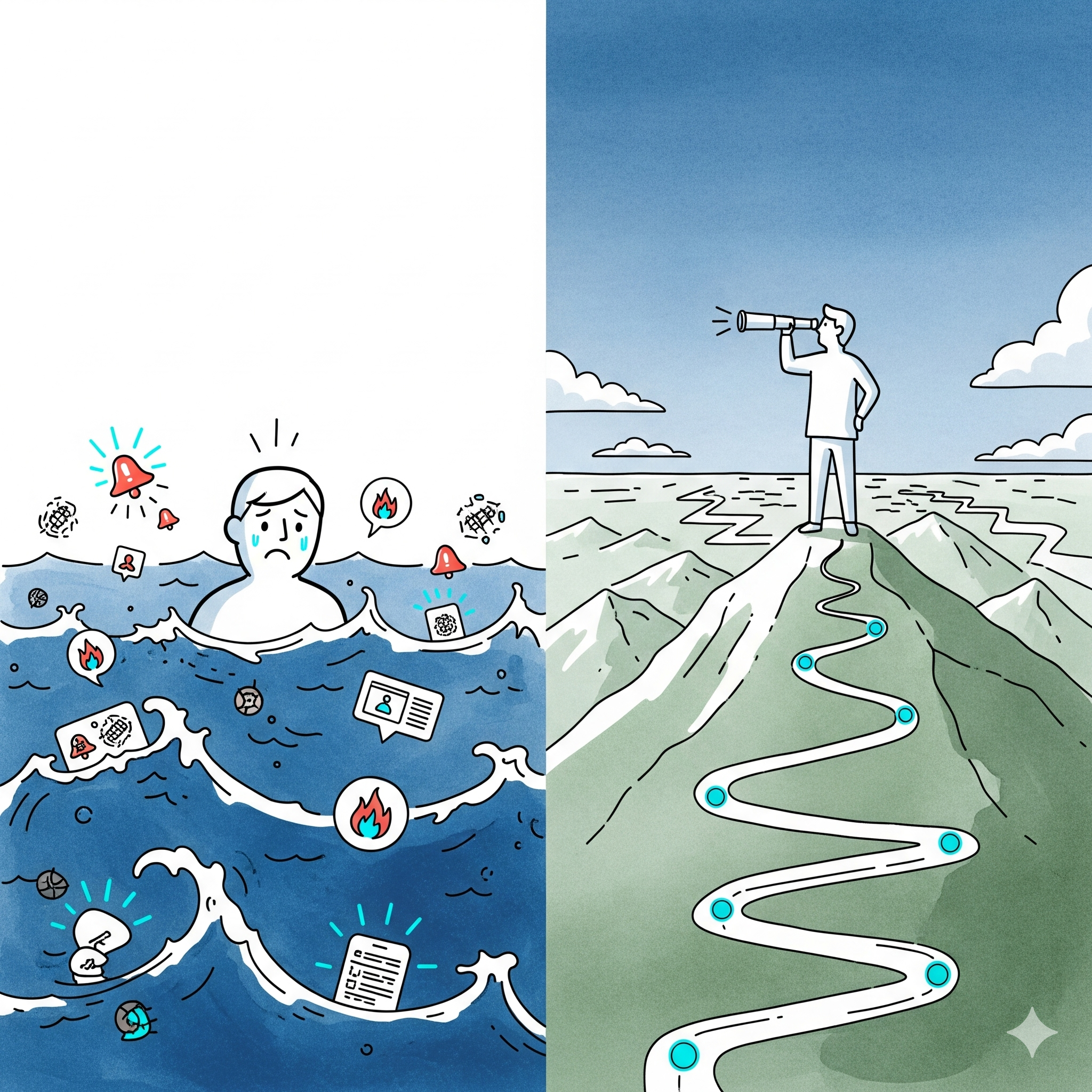
When Growth Nearly Broke Me
Several years ago, I faced every PM's dream and nightmare simultaneously. Due to significant turnover on our team, I went from product managing 2 teams in one time zone to overseeing 7 teams across 5 time zones within a single year.
On one hand, it was incredible. I finally had the end-to-end control I'd always wanted. No more working through gatekeepers with conflicting agendas. No more watching great projects die in committee. I could actually execute on the bigger initiatives that had been frustrating me for years.
But the reality was brutal.
Each team needed constant support. Every day brought new fires to fight. I was keeping things running, but barely. We weren't planning for the future, we were just surviving each sprint. I was trapped in what I now call the "reactive leadership trap" -- your success actually makes things worse because more responsibility gets piled on without any way to handle it.
The breaking point came when I realized I was making the same decisions over and over again. Teams were escalating similar issues daily. I was the bottleneck for decisions that should have been automated or delegated months earlier.
That's when I made the crucial decision: I convinced my manager to let me build a team with additional PMs to help me out, but more importantly, I started building systems to scale strategic thinking rather than just tactical execution.
The transformation took some time. But by the end, those 7 teams weren't just running smoothly, they were innovating at a pace we'd never achieved before.
Building those systems worked. But I later discovered the same principle -- replacing personal heroics with structural solutions -- applies at an even bigger scale.
The Cross-Functional Breakthrough
At a large company where I worked, we faced a different but related challenge. We had many small, empowered teams, each solving specific customer problems effectively. Great for autonomy, but it created an unexpected limitation.
We were stuck making small iterative improvements instead of tackling anything transformational.
Each team optimized their own metrics, but we lacked the coordination to pursue opportunities that required multiple teams working in sync. Big initiatives were impossible because no single team owned them, and cross-functional collaboration was too ad hoc to sustain complex projects.
I worked with other PMs to create a monthly braintrust meeting where we could discuss market trends, industry shifts, and competitive moves. More importantly, we used this space to identify and advocate for bigger projects that needed cross-functional coordination.
Within six months, we had kicked off several multi-million dollar initiatives that no individual team could have conceived or executed alone. We had gone from a collection of optimizing teams to a coordinated strategic force.
The Pattern Behind Both Stories
Looking back, these two experiences taught me the same lesson at different scales. With my 7 teams, I was the bottleneck because every decision flowed through me. Across the larger organization, strategic thinking was bottlenecked because no structure existed for cross-team coordination. In both cases, the fix wasn't working harder -- it was building a system that made strategic thinking the default.
If you're stuck in the reactive trap now, here's what I'd suggest based on what worked for me.
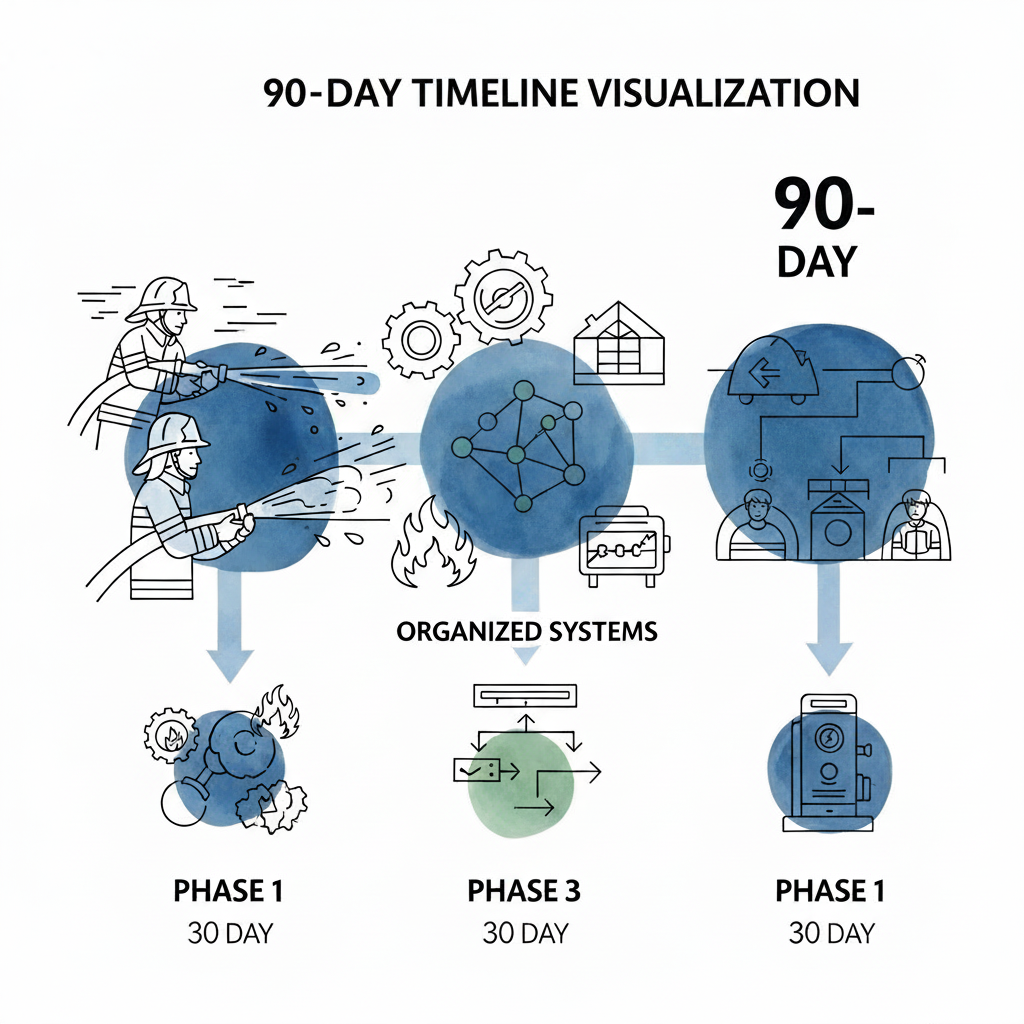
Weeks 1-2: Measure reality. Track your time for two full weeks. Categorize everything as reactive or strategic. Identify the top 5 recurring issues that pull you into firefighting mode. I wish I'd done this earlier with my 7 teams -- I would have seen sooner that the same types of decisions were eating my entire calendar.
Weeks 3-6: Build systems that remove you as the bottleneck. For each recurring problem, create a framework or process so the decision doesn't need you. Automate frequent decisions with clear criteria. Establish decision-making authority at the right levels. This is what finally freed me -- not hiring more people, but giving teams the guardrails to make their own calls.
Weeks 7-12: Invest the reclaimed time in cross-functional strategic work. Use those freed-up hours for the work that actually moves the needle: scenario planning, strategic roadmap reviews, and -- critically -- building the cross-functional relationships that enable breakthroughs. Our monthly braintrust didn't require anyone to work more hours. It just gave us a place to think together about things no single team could see.
I went from drowning across 7 teams to watching those teams innovate on their own. Later, I helped an organization go from a collection of small teams optimizing in isolation to a coordinated force launching multi-million dollar initiatives. In both cases, the breakthrough came from the same place: I stopped trying to be the hero and started building the systems that made strategic thinking possible for everyone.