Framework

Scenario Planning for Product Managers: Preparing for Multiple Futures in Uncertain Markets

Most product managers build strategies as if the future were predictable. The most resilient product organizations don't try to predict the future. Instead, they prepare for multiple futures simultaneously.

By Adaptable Product 12 min read
Scenario Planning and Strategic Foresight
Executive Summary

Most product managers build strategies as if the future were predictable. They create detailed roadmaps, set confident timelines, and allocate resources based on a single vision of what's coming next. Then reality strikes with unexpected competitors, new technologies, regulation changes, or dramatic consumer behavior shifts. The most resilient product organizations use systematic scenario planning to identify trends, draft multiple plausible futures, and build adaptive strategies that work regardless of which scenario emerges, transforming uncertainty from a threat into competitive advantage.

When AI Rewrote the Rules Overnight

I experienced this lesson firsthand while working at an online education company that served millions of college students worldwide. We had built a robust marketplace connecting students with a vast library of content from professors, peer notes, research papers, and tutoring support. Our legal department worked tirelessly to ensure compliance across different countries and institutions. The business was thriving with steady, predictable growth.

Then AI arrived, and everything changed.

Suddenly, students didn't need to research multiple sources. They had one chat window that could synthesize information instantly. They didn't need tutors for most questions. They didn't even need to write original content anymore. Our entire value proposition was being commoditized by a technology that barely existed six months earlier.

To the company's credit, we did experiment with new business models. We built our own AI layer that could consolidate and personalize our content for specific student needs. We already had data scientists, machine learning experts, and AI developers who were excited to build solutions for this new reality.

But here's where scenario planning would have made all the difference: the executive team wasn't prepared for this level of fundamental disruption.

They had built their careers on decades of steady, predictable growth. An existential threat was beyond their adaptive capacity. Leadership made one big bet. And while we did get a chance to iterate and show some progress, it wasn't fast or deep enough to compete with the worldwide forces against us. The one bet failed to turn the business around. After that, leadership was out of ideas and patience. They chose to shut down the business rather than double down on adaptation.

For those of us who wanted to compete in this new reality, it was a devastating missed opportunity. The infrastructure, talent, brand, and customer relationships were all there. What was missing was a leadership mindset prepared for multiple possible futures.

If we had been using systematic scenario planning, we would have identified AI as a critical trend months earlier. We would have developed strategies for different AI adoption scenarios. Most importantly, we would have built organizational capabilities for rapid experimentation and adaptation before we needed them.

PESTLE Analysis and Strategic Planning Framework

The PESTLE-Powered Scenario Planning Framework

Step 1: Systematic Trend Identification Through PESTLE Analysis

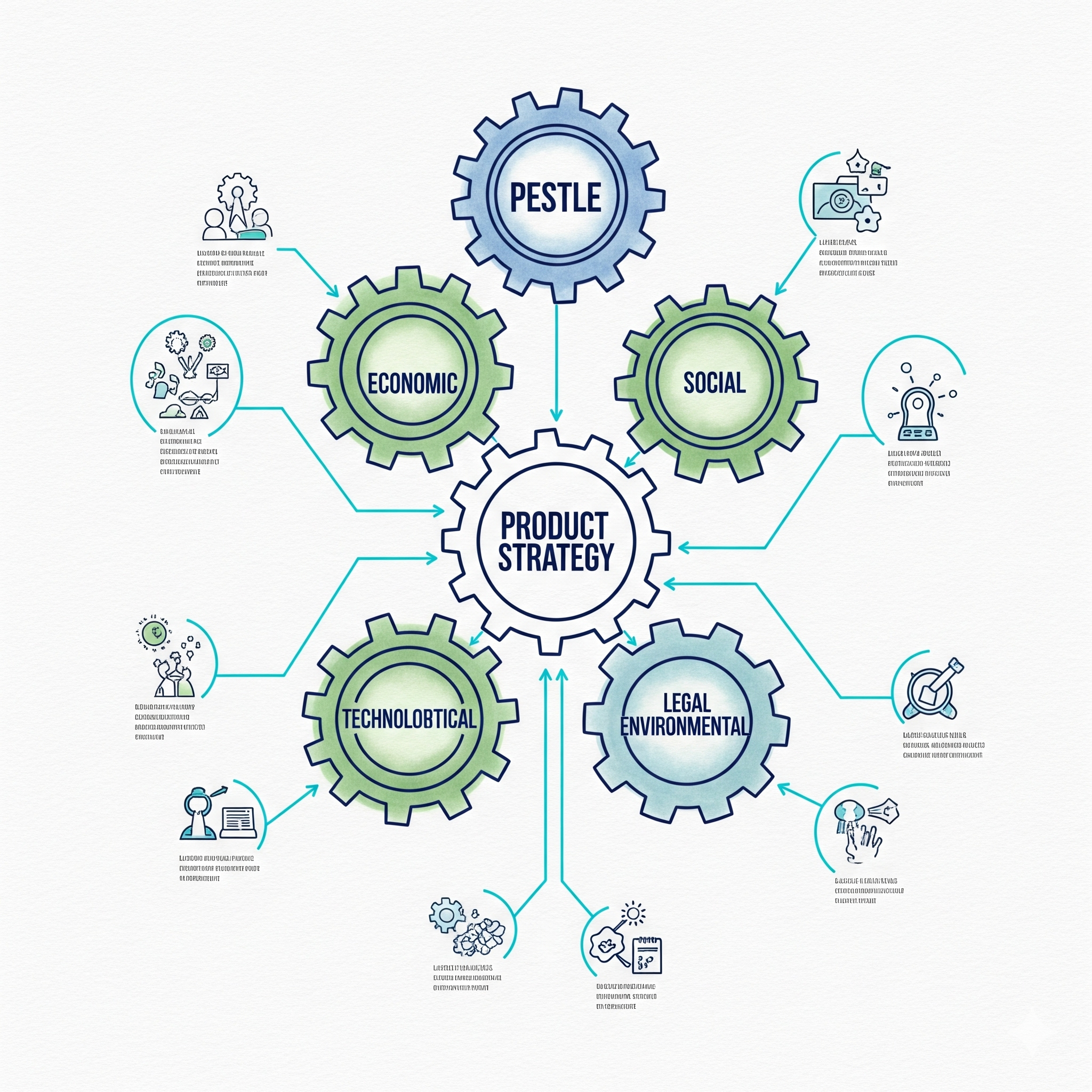
Most product managers monitor trends informally, picking up signals from conferences, articles, or conversations. Systematic scenario planning starts with comprehensive PESTLE analysis: Political, Economic, Social, Technological, Legal, and Environmental factors that could reshape your market.

Political Factors: Changes in government policies, international trade agreements, regulatory priorities, and political stability that could affect your product or market access.

Economic Factors: Interest rate trends, inflation patterns, employment shifts, and economic growth patterns that influence customer spending and business investment.

Social Factors: Demographic changes, lifestyle shifts, cultural trends, and generational preferences that reshape customer needs and behaviors.

Technological Factors: Emerging technologies, automation trends, digital transformation patterns, and infrastructure changes that could disrupt your industry or create new opportunities.

Legal Factors: Regulatory changes, compliance requirements, tariff policies, intellectual property trends, and legal precedents that could constrain or enable your product strategy.

Environmental Factors: Climate change impacts, sustainability requirements, resource availability, and environmental regulations that affect operations and customer values.

The goal is to identify 8-10 key trends that could significantly impact your product space over the next 2-5 years. Don't just collect trends; analyze how they might interact with each other and compound over time.

Step 2: Multi-Scenario Development

Once you've identified key trends, create 3-4 distinct future scenarios based on different combinations of how those trends might play out. Each scenario should be plausible but different enough to require different strategic responses.

Scenario A: Accelerated Digital Transformation
What happens if remote work becomes permanent, AI adoption accelerates, and digital-first becomes the default for all business interactions?

Scenario B: Regulatory Backlash
What happens if governments crack down on data privacy, AI development faces heavy regulation, and compliance costs increase dramatically?

Scenario C: Economic Contraction
What happens if economic growth slows, customer budgets tighten, and businesses prioritize cost-cutting over innovation?

Scenario D: Sustainability Imperative
What happens if environmental concerns and high energy costs become the primary driver of purchasing decisions and regulatory focus?

For each scenario, describe how it would affect customer behavior, competitive dynamics, technology adoption, regulatory environment, and resource availability. Be specific about timelines, magnitudes of change, and interconnected effects.

Step 3: Adaptive Strategy Building

The power of scenario planning isn't in predicting which future will happen. It's in building strategies that work across multiple possible futures and creating early warning systems that help you recognize which scenario is emerging.

Robust Strategy Development: Identify product strategies, feature priorities, and resource allocations that perform well across most scenarios. These become your core strategic bets.

Contingency Planning: For strategies that only work in specific scenarios, develop contingency plans that can be activated quickly when early signals indicate a particular future is emerging.

Early Warning Systems: Define specific, measurable indicators that would signal each scenario is becoming more likely. Monitor these indicators systematically and create decision triggers for when to activate contingency plans.

Portfolio Approach: Instead of betting everything on one future, create a portfolio of initiatives that hedge against different scenarios while positioning for upside in each.

The Evidence: Why Systematic Scenario Planning Works

Research consistently validates the competitive advantage of systematic scenario planning for product organizations. McKinsey's Strategy Research found that companies using systematic scenario planning achieve 56% better performance during market disruptions and recover 78% faster from unexpected changes.

MIT's Strategic Planning Study revealed that product teams implementing PESTLE analysis identify market opportunities 45% earlier and avoid strategic blindsides 67% more effectively than those using linear planning approaches.

Stanford's Strategic Management Research showed that organizations with multi-scenario product strategies report 34% higher adaptability scores and 23% better long-term market positioning compared to single-future planning approaches.

As Rita McGrath from Columbia Business School explains, "In uncertain environments, the goal isn't to predict the future; it's to be prepared for multiple futures. Scenario planning is your competitive insurance policy."

Roger Martin, renowned strategy expert, adds crucial context: "The best product strategies aren't right or wrong; they're robust across different possible worlds. That requires systematic thinking about what those worlds might look like."

Your 60-Day Scenario Planning Implementation

Weeks 1-2: PESTLE Analysis Foundation

  • Conduct comprehensive PESTLE analysis for your product space
  • Identify 8-10 key trends with potential significant impact
  • Research how these trends might interact and compound over time

Weeks 3-4: Scenario Development

  • Draft 3-4 distinct future scenarios based on different trend combinations
  • Describe specific impacts on customers, competition, and market dynamics for each scenario
  • Validate scenarios with diverse stakeholders and external experts

Weeks 5-6: Strategy Mapping

  • Evaluate your current product strategy against each scenario
  • Identify which elements work across multiple futures vs. scenario-specific strategies
  • Develop contingency plans for scenario-dependent strategies

Weeks 7-8: Implementation Systems

  • Create early warning indicator monitoring systems
  • Establish decision triggers for activating contingency plans
  • Train your team on scenario-based decision-making processes

Beyond Prediction: Building Adaptive Intelligence

The most important insight from systematic scenario planning isn't that it helps you predict the future. It's that it builds organizational capability for rapid adaptation regardless of which future emerges. Teams that regularly engage with multiple possible futures become more comfortable with uncertainty, better at pattern recognition, and faster at strategic pivoting when circumstances change.

This adaptive intelligence becomes your sustainable competitive advantage. While competitors struggle to adapt to unexpected changes, your team is already prepared with strategies, relationships, and capabilities that work across different futures.

Key Takeaways:
  • Systematic scenario planning transforms uncertainty from threat into competitive advantage
  • PESTLE analysis provides comprehensive framework for identifying trends across Political, Economic, Social, Technological, Legal, and Environmental factors
  • Create 3-4 plausible scenarios that require different strategic responses, not just variations on current strategy
  • Build robust strategies that work across multiple futures plus contingency plans for scenario-specific opportunities
  • Establish early warning systems and decision triggers to recognize which scenario is emerging

Ready to Build Scenario Planning Capabilities?

Explore our Adaptable Product Framework course to learn systematic tools for PESTLE analysis, scenario development, and adaptive strategy building that prepare your organization for multiple possible futures.

Related Articles

Framework
Existential Questions as a Strategic Tool: How Product Managers Use Deep Inquiry for Breakthrough Innovation

I joined a company building a new user experience with three interfaces for image uploads and moderation. The roadmap was packed, engineering estimates were intimidating, and everyone seemed resigned to building three complex systems.

13 min read Read More
Framework
The Adaptive Advantage: How Anti-Fragile Product Teams Get Stronger Through Disruption

I took over a product that had been launched as a side project with no validation or rules, creating a data integrity nightmare with duplicate, conflicting, and incomplete data.

14 min read Read More
Framework
Data-Informed vs. Data-Driven: The Critical Difference That Determines Product Success

Product managers are drowning in data and analytics tools, creating a dangerous false belief that more data automatically leads to better decisions.

14 min read Read More