When Crisis Becomes Catalyst for Transformation
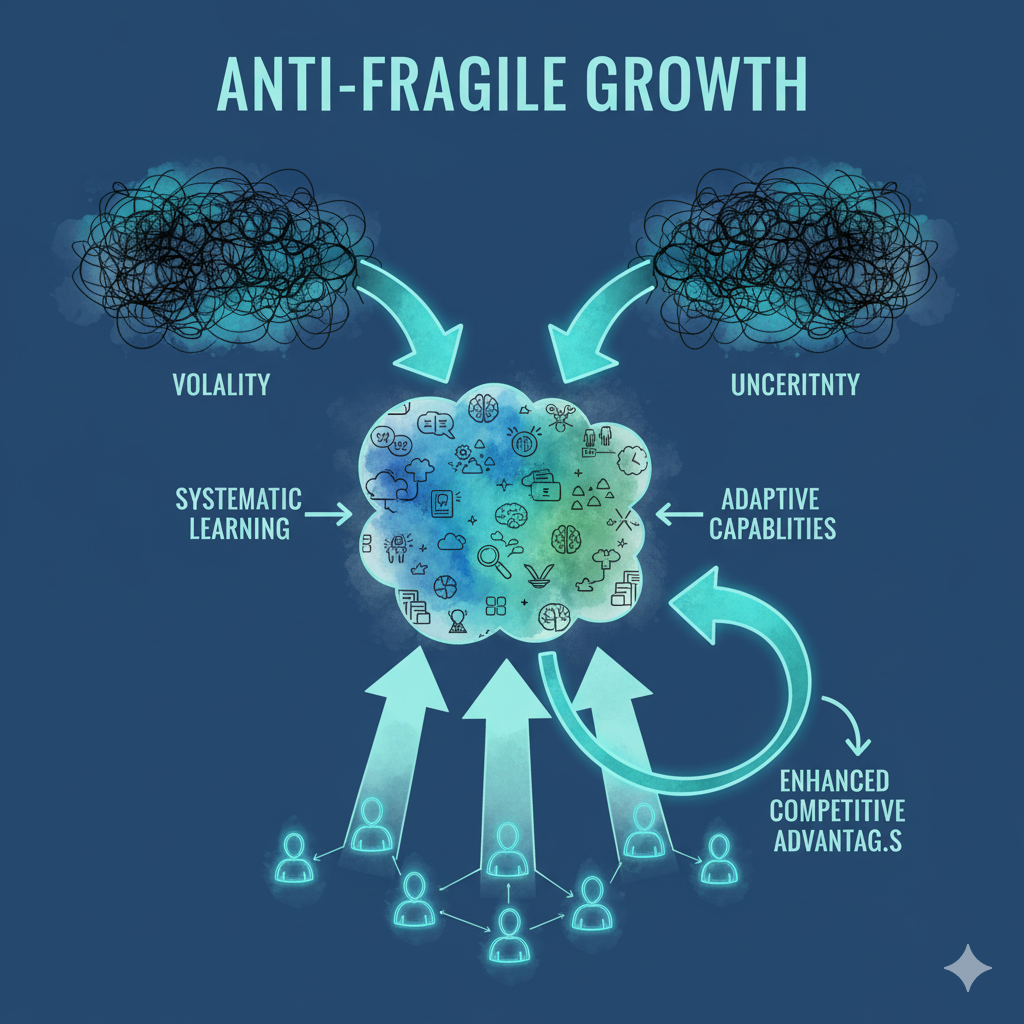
I took over a product that had been launched as a side project with no validation or rules, creating a data integrity nightmare with duplicate, conflicting, and incomplete data. My job was to clean up this mess and scale from $5M to $100M in a few months. Most teams would have seen this as a crisis to manage. But we saw something different: an opportunity to solve a systemic problem that had been plaguing our entire organization. Instead of just building a validation service for this particular product, we built a service that worked across all data ingest points. This became the foundation for a whole new content management service, helped us clean up our entire data catalog, and positioned us perfectly for a large migration project. What started as a crisis became the catalyst for building one of our most valuable internal services. We didn't just survive the disruption—we used it to get stronger, smarter, and more competitive than before.
Beyond Resilience: The Anti-Fragile Mindset
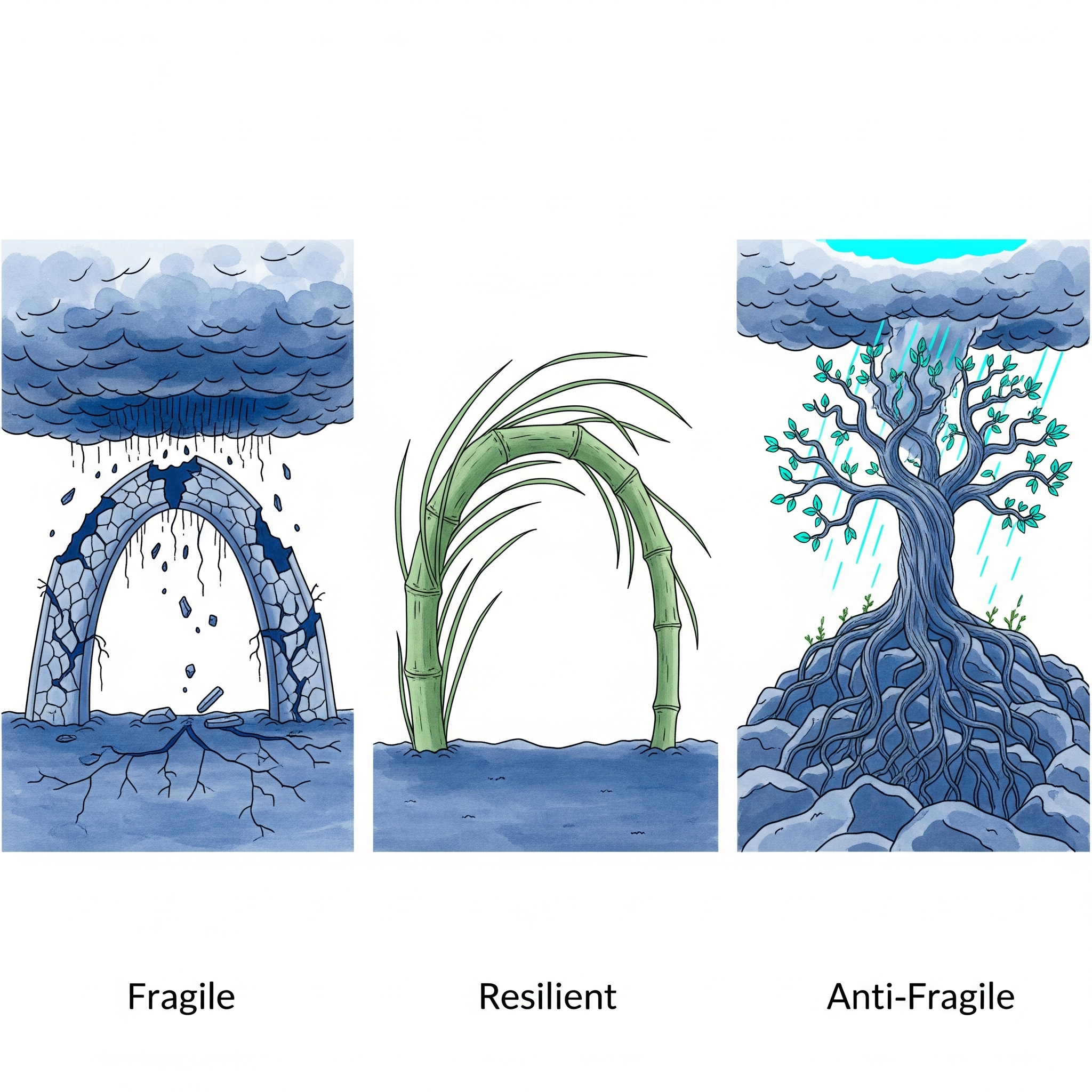
Most product teams aspire to resilience. They want to survive market downturns, weather competitive threats, and bounce back from setbacks. Resilience is good, but it's fundamentally a defensive posture. Resilient teams return to their previous state after disruption. They survive, but they don't gain lasting advantage from the experience.
This defensive mindset creates several limitations:
It treats disruption as something to endure rather than exploit. Resilient teams focus on minimizing damage and returning to normal operations. They miss opportunities to use volatility as fuel for breakthrough innovation or competitive positioning.
It aims for recovery, not improvement. The goal becomes getting back to where you were before, rather than using the disruption as a catalyst to reach somewhere better than you've ever been.
It creates reactive rather than adaptive systems. Resilient teams build defenses against known threats but struggle when disruption comes from unexpected directions or creates entirely new categories of challenge and opportunity.
It limits learning velocity during critical moments. When teams are focused on survival, they often slow down experimentation and learning at precisely the moments when rapid adaptation could create lasting advantages.
The concept of anti-fragility, introduced by Nassim Nicholas Taleb, offers a fundamentally different approach. Anti-fragile systems don't just survive stress and volatility. They actually get stronger because of it. They use disruption as fuel for growth, learning, and competitive advantage.
The Anti-Fragile Advantage in Product Management
Anti-fragile product teams operate with a fundamentally different relationship to uncertainty and disruption. Instead of seeing market volatility, competitive pressure, or internal challenges as obstacles to overcome, they see them as information to process and energy to harness.
They thrive on volatility. Market uncertainty creates opportunities for rapid experimentation, customer discovery, and strategic repositioning that wouldn't be possible in stable environments. Anti-fragile teams use chaos to test assumptions, validate strategies, and discover breakthrough insights.
They learn faster under pressure. While resilient teams slow down during crisis to minimize risk, anti-fragile teams accelerate learning cycles to capture insights that emerge during periods of high information flow and rapid change.
They build strength through stress. Each challenge becomes an opportunity to build capabilities, systems, and strategic positions that make the team stronger for future challenges. Problems become training grounds for developing competitive advantages.
MIT's 2024 Organizational Resilience Study validates this approach: teams with anti-fragile characteristics show 89% better performance during market disruptions and achieve 67% higher growth rates in volatile environments compared to traditionally resilient teams.
The Three-Pillar Framework for Anti-Fragile Product Teams
Based on research from complexity science and my experience building adaptive product organizations, here's a systematic approach to moving beyond resilience toward anti-fragility:
Pillar 1: Anti-Fragile System Design
Audit current team and product systems for fragile elements. Identify the parts of your product, processes, and team structures that break under pressure or perform worse during volatile periods. Look for single points of failure, rigid processes that can't adapt to changing conditions, and systems that require stable environments to function effectively.
Design redundancy and optionality into critical processes. Build multiple ways to achieve important outcomes rather than relying on single approaches. Create backup systems not just for technical infrastructure but for decision-making, customer communication, and strategic planning. Give yourself options when conditions change rapidly.
Create mechanisms that actually improve under stress. Design systems that get stronger when challenged rather than just surviving challenge. This might include learning systems that accelerate under pressure, decision-making processes that become more effective during uncertainty, or customer feedback loops that provide more valuable insights during volatile periods.
The key insight is that anti-fragile systems aren't just robust. They're designed to extract benefit from the very forces that would damage fragile systems.
Pillar 2: Volatility Harnessing Framework
Develop systematic approaches to turning market uncertainty into competitive advantage. Create processes for rapid market sensing, opportunity identification, and strategic pivoting that allow you to move faster than competitors during uncertain periods. Build capabilities for turning volatility into information and information into strategic advantage.
Create rapid learning cycles that accelerate during disruption. Design experimentation frameworks that can scale up quickly when conditions create opportunities for learning. Develop customer discovery processes that extract maximum insight from periods when customer behavior and market conditions are changing rapidly.
Build sensing systems that detect opportunity within apparent chaos. Establish monitoring and analysis capabilities that help you identify patterns, opportunities, and strategic insights even when market conditions appear chaotic or unpredictable. Create early warning systems that detect both threats and opportunities before competitors recognize them.
Rita McGrath, the edge strategy expert, captures this approach: "The companies that win in uncertain environments don't just adapt to change; they use uncertainty as fuel for innovation and competitive advantage."
Pillar 3: Continuous Adaptation Culture
Establish team practices that embrace uncertainty as growth opportunity. Build team norms and processes that treat volatility as information rather than threat. Create psychological safety for experimentation during uncertain periods rather than defaulting to risk-averse behaviors when conditions become challenging.
Create feedback loops that strengthen decision-making under pressure. Develop systems that help teams make better decisions when information is incomplete and conditions are changing rapidly. Build processes for rapid iteration, quick failure recognition, and fast strategy adjustment that actually improve when the pace of change accelerates.
Build organizational muscle memory for thriving during volatile periods. Create practices, systems, and cultural elements that help the team perform better during disruption rather than just surviving it. Develop institutional knowledge about how to harness volatility rather than just endure it.
John Boyd, the strategic thinking pioneer, understood this principle: "In rapidly changing environments, the advantage goes not to the big or the fast, but to those who can observe, orient, decide, and act more effectively than their competitors."
Evidence for the Anti-Fragile Approach
The research supporting anti-fragile approaches is compelling. Harvard Business School's 2023 Adaptive Systems Research found that organizations that systematically build anti-fragile capabilities report 45% faster recovery from setbacks and 78% better long-term competitive positioning.
Stanford's 2024 Complexity Science Research showed that product teams implementing anti-fragile principles demonstrate 56% higher innovation rates during uncertain periods and 34% better strategic outcomes over 3-5 year periods.
But the real proof comes from practical results. When product teams master anti-fragile approaches:
- Performance improves during disruption rather than declining, creating competitive advantages when others are struggling
- Learning accelerates under pressure as teams extract maximum insight from periods of high information flow
- Strategic positioning strengthens through challenges that would weaken traditionally resilient teams
- Innovation rates increase during volatile periods when other teams slow down experimentation
- Competitive advantages compound over time as each disruption becomes a source of new capabilities and insights
The key insight is that the teams who thrive long-term aren't those who avoid disruption. They're those who transform disruption into fuel for continuous competitive advantage.
Your Next Steps: Building Anti-Fragile Capabilities
Ready to move beyond resilience toward anti-fragility? Here are three actions you can implement immediately:
1. Conduct Your Fragility Audit (This Week): Identify the top three elements of your current product and team systems that perform worse under pressure or break during volatile conditions. For each fragile element, brainstorm how it could be redesigned to get stronger rather than weaker when stressed.
2. Design Your First Volatility Harness (Next Two Weeks): Choose one area where market uncertainty or competitive pressure currently creates challenges for your team. Design a systematic approach to turn that volatility into competitive advantage. This might be a rapid learning cycle, an opportunity sensing system, or an adaptive strategy framework.
3. Build Anti-Fragile Team Practices (Next 30 Days): Establish one regular team practice that helps you thrive during uncertainty rather than just surviving it. This might be weekly volatility opportunity reviews, monthly assumption stress-testing sessions, or quarterly anti-fragile system assessments.
Transform Disruption Into Your Greatest Asset
The most successful product managers understand that competitive advantage doesn't come from avoiding disruption. It comes from getting better at using disruption as fuel for growth, learning, and strategic positioning. When you build anti-fragile capabilities, you don't just prepare for the next challenge. You prepare to use that challenge to become stronger than your competition.
The question isn't whether you'll face market volatility, competitive disruption, or internal challenges. You will. The question is whether you'll have the systems, mindset, and capabilities to transform those challenges into competitive advantages.
Key Takeaways:
- Anti-fragile systems get stronger through stress and volatility, achieving 89% better performance during disruptions
- Moving beyond resilience means treating disruption as fuel for growth rather than obstacles to endure
- The three pillars: Anti-Fragile System Design, Volatility Harnessing Framework, and Continuous Adaptation Culture
- Build redundancy, optionality, and mechanisms that improve under stress rather than just surviving challenge
- Start with fragility audits, design volatility harnesses, and establish team practices that thrive during uncertainty