Framework

The Consultation Revolution: Transforming Every Product Meeting from Time-Waster to Game-Changer

Most product meetings are structured for performative reaction when they should be designed for decision-making. When you apply systematic consultation principles, you can cut meeting time by nearly half while dramatically improving decision quality.

By Adaptable Product 11 min read
Product Meeting Transformation and Consultation Methods
Executive Summary

If you're like most product managers, you spend 60-80% of your time in meetings that feel like productivity black holes. The problem isn't that you're having too many meetings. The problem is that most product meetings are structured for performative reaction when they should be designed for decision-making. When you apply systematic consultation principles to every type of product meeting, you can cut meeting time by nearly half while dramatically improving decision quality, creating clarity, alignment, and commitment in record time.

When Customer Service Became My Secret Weapon

I learned the power of consultation-based meetings while working with our customer service team at a previous company. Initially, our monthly meetings followed the standard format: I would present upcoming feature releases, planned maintenance windows, and other information the agents needed to know. They would ask clarifying questions, and we'd wrap up in thirty minutes.

But I wanted to transform these agents from passive recipients of product updates into active contributors to our product roadmap. This required completely changing how our meetings worked.

The first few sessions were awkward. I asked them for their product ideas and suggestions. But when agents brought up feature ideas, I then asked for evidence. As a product manager, I couldn't just act on "because customers will like it" or "because I heard someone mention it once." I needed some data to help weight their suggestions against all the other items in my backlog. From customer service, I needed ticket counts, customer verbatims, specific requests from sales leads, or quantifiable trends in support interactions.

Initially, the agents pushed back. Gathering this evidence felt like busywork that would slow down their ticket resolution times. But something transformative happened as we continued the consultation process: they started to see the purpose behind the data collection.

The agents realized that proper tagging and documentation weren't just administrative tasks. They were building cases that could drive real product changes.

Their insights could influence the roadmap. Their contributions could be highlighted in performance reviews and team meetings. They went from being order-takers to being strategic partners.

The results were extraordinary. The team started tagging tickets more effectively. They found creative ways to identify trends in the data. They asked more follow up questions when on the phone to customers. They became sources of key information about the product, the market, the industry, even our competitors who were trying to steal them away from us.

Our meetings improved dramatically. Our products got better because we were solving real customer problems with quantified evidence. Our customer service analytics became more valuable because agents understood how their data was being used. Most importantly, the agents' job satisfaction increased because they had genuine influence over the products they supported every day.

All because we transformed a one-way information dump into an ongoing consultation on how we could better serve customers together.
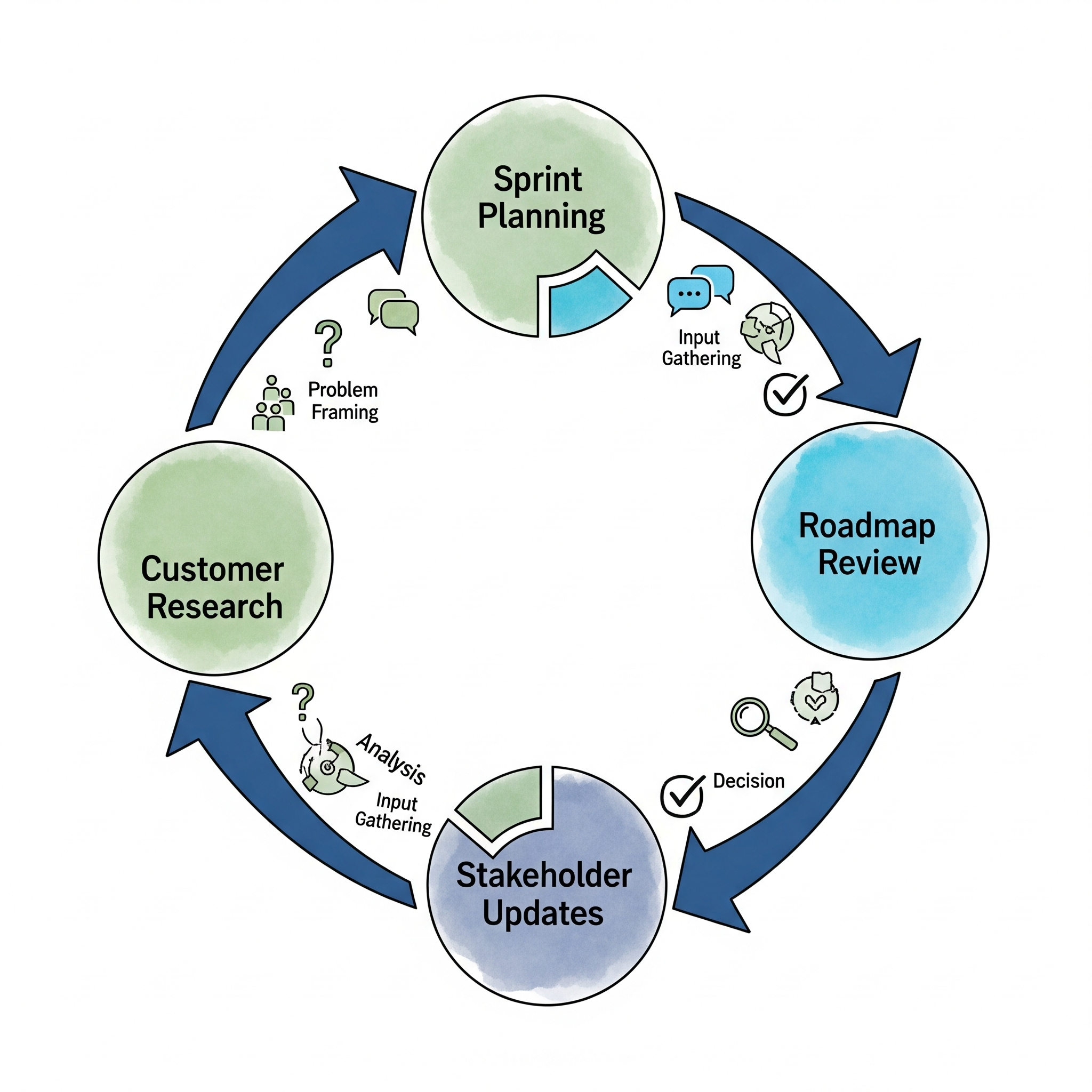
Consultation-Based Meeting Framework and Decision Making

The Four Pillars of Consultation-Based Product Meetings

1. Clear Problem Framing

Most meetings fail before they start because participants don't agree on what problem they're solving. Consultation-based meetings begin with explicit problem framing that everyone understands and accepts.

The Problem Statement Framework: Every meeting agenda should start with a clear, specific problem statement. Not "discuss the roadmap" but "decide which three features to prioritize for Q2 given our capacity constraints and customer feedback." Not "update on user research" but "determine whether our current value proposition resonates with target customers based on recent interviews."

Success Criteria Definition: Before any discussion begins, define what success looks like. What decision needs to be made? What information needs to be gathered? What alignment needs to be achieved? Make the meeting's purpose so clear that everyone knows whether it succeeded or failed.

Scope Boundaries: Explicitly state what's in scope and what's out of scope for the meeting. This prevents scope creep and keeps discussions focused on the actual decision at hand. Set up a 'parking lot' for important points that should be saved for after the goal of the meeting is achieved.

2. Structured Input Gathering

Traditional meetings rely on whoever speaks loudest or most frequently. Consultation-based meetings systematically gather input from all relevant perspectives.

Pre-Work Requirements: Send specific questions or data requests before the meeting so participants come prepared with relevant information.

Inclusive Participation Design: Use structured techniques like round-robin sharing, silent brainstorming, or role-based perspectives to ensure all voices are heard, not just the most confident speakers.

Evidence-Based Contributions: Require participants to support opinions with data, examples, or specific observations. This elevates the quality of input and prevents meetings from devolving into opinion exchanges.

3. Systematic Analysis

Once you've gathered input, consultation-based meetings use structured analysis techniques to evaluate options and build toward decisions.

Option Generation: Systematically generate multiple approaches to the problem before evaluating any single option. This prevents premature convergence on obvious but suboptimal solutions. Even if the solution seems obvious, take the time to 'steelman' the alternatives to ensure you have challenged your assumptions.

Criteria-Based Evaluation: Use explicit criteria to evaluate options. What are the trade-offs? What are the resource requirements? What are the risks and potential outcomes? Make your decision-making logic transparent and consistent.

Collective Intelligence Synthesis: Instead of defaulting to the highest-paid person's opinion (HIPO), use structured processes to synthesize diverse perspectives into better decisions than any individual could make alone.

4. Explicit Decision Protocols

The most frustrating meetings are those where you think a decision was made, only to discover later that different people understood different things. Consultation-based meetings end with crystal-clear decisions and next steps.

Decision Documentation: Explicitly state what was decided, who is responsible for what, and when things will happen. Document the reasoning behind decisions so future discussions can build on previous thinking.

Commitment Mechanisms: Use techniques like "disagree and commit" to ensure that even if someone didn't advocate for the final decision, they're committed to making it work.

Follow-Up Systems: Build accountability into every meeting with clear next steps, deadlines, and check-in processes.

The Evidence: Why Consultation-Based Meetings Work

Research consistently validates the superiority of consultation-based meeting approaches. MIT's Meeting Effectiveness Study found that teams implementing consultation-based meeting structures reduce total meeting time by 42% while improving decision satisfaction scores by 67%.

Harvard Business School's Collaboration Research revealed that structured consultation processes increase stakeholder alignment by 78% and reduce decision reversal rates by 56% compared to traditional discussion-based meetings.

Stanford Design School Research showed that product teams using consultation frameworks in customer research generate 89% more actionable insights and achieve 34% better product-market fit outcomes.

As Patrick Lencioni, organizational health expert, explains: "The best meetings aren't about discussion; they're about decision. Consultation provides the structure that turns conversation into commitment."

Michael Wilkinson, meeting facilitation expert, adds crucial insight: "Most meetings fail because they try to solve problems without first agreeing on what problem they're solving. Consultation forces that clarity upfront."

Your 30-Day Meeting Transformation

Week 1: Meeting Audit

  • Catalog all your recurring product meetings and identify the primary decision-making challenges in each
  • Survey team members about meeting effectiveness and specific frustrations
  • Choose 2-3 meetings to redesign using consultation principles

Week 2: Template Development

  • Create consultation-based templates for your selected meetings
  • Include problem framing, pre-work requirements, facilitation guides, and decision documentation standards
  • Train key stakeholders on the new meeting structure

Week 3: Implementation and Refinement

  • Run pilot meetings using consultation frameworks
  • Gather feedback and refine processes based on initial results
  • Document what works and what needs adjustment

Week 4: Scaling and Culture Change

  • Expand consultation principles to additional meetings
  • Establish meeting effectiveness metrics to track improvement over time
  • Begin training other team members on consultation techniques

Beyond Better Meetings: Building Decision-Making Capability

The real power of consultation-based meetings isn't just that they're more efficient. They build organizational capability for better decision-making across all contexts. Teams that regularly practice structured consultation become better at problem identification, evidence gathering, systematic analysis, and commitment building.

This creates a compound advantage. Not only do you waste less time in meetings, but the decisions you make in those meetings are higher quality, more widely supported, and more likely to be executed successfully.

Key Takeaways:
  • Most product meetings are structured for performative reaction rather than decision-making
  • The four pillars: Clear Problem Framing, Structured Input Gathering, Systematic Analysis, and Explicit Decision Protocols
  • Start every meeting with explicit problem statements and success criteria that everyone understands
  • Use evidence-based contributions and structured techniques to ensure all voices are heard effectively
  • End with crystal-clear decisions, documented reasoning, and accountability mechanisms for follow-through

Ready to Transform Your Product Meetings?

Explore our Adaptable Product Framework course that includes detailed consultation templates and facilitation guides for every type of product meeting, revolutionizing how your organization operates.

Related Articles

Leadership
The Remote Product Leader's Playbook: Building Adaptive Teams Across Distance

The traditional playbook for product leadership breaks down when you can't read body language in hallway conversations or build trust through shared coffee breaks.

10 min read Read More
Framework
Scenario Planning for Product Leaders: Building Multiple Futures in Uncertain Markets

Most product managers build strategies as if the future were predictable. They create detailed roadmaps, set confident timelines, and allocate resources based on a single vision.

12 min read Read More
Leadership
How Product Managers Drive Organizational Change Without Authority

I worked at a company that had acquired five big competitors in two years in a roll-up strategy. My job, as a platform PM, was to get everyone aligned on a unified technology stack.

14 min read Read More