
When Cultural Distance Became My Greatest Teacher
I learned this lesson the hard way while managing development teams across three continents. From the beginning, I realized that cultural differences between teams would be our biggest challenge, but I had no idea how much it would reshape my understanding of leadership itself.
My team in Southeast Asia came from a culture where hierarchy and respect for authority were fundamental values. Initially, I interpreted their quiet agreement with my suggestions as alignment, but our execution kept falling short. They weren't sharing ideas, pitching alternatives, or taking ownership over the development process. They were simply doing exactly what I asked, nothing more. They didn't realize they had 'permission' to push back on my ideas or suggest improvements.
Meanwhile, halfway around the world, I had a team from an extremely egalitarian culture where questioning authority was not just acceptable but expected. Every suggestion I made was met with immediate pushback and heated debate. Initially, I found myself getting defensive and frustrated, thinking they were trying to undermine my leadership.
The breakthrough came when I realized that in both cases, the teams were actually trying to help me succeed, but they were expressing it in completely different ways. The quiet team's silence wasn't agreement -- it was a sign that there was a problem I was missing. The argumentative team's heated debates weren't attempts to derail my ideas -- they were signs of engagement and careful thinking about implementation challenges.
This realization forced me to develop new systems for reading virtual body language, building relationships across cultural contexts, and creating structured ways for different communication styles to contribute. Within six months, our distributed team was generating more innovative solutions and making better decisions than any co-located team I had ever managed.
What Made This Work: Intentional Systems
That experience taught me that remote leadership isn't harder than in-person leadership -- it's just more intentional. The systems I had to build for my distributed teams turned out to be better than what most co-located teams ever develop. Three areas mattered most.
Psychological safety had to be built differently for each team. My Southeast Asian team needed explicit permission to disagree -- I started asking individuals directly for alternative approaches and praising pushback when it happened, until they trusted that dissent was genuinely welcome. My European team needed structured ways to channel their debates productively, so that passionate disagreement led to decisions rather than endless loops. Both teams needed psychological safety, but it looked completely different in practice. I ran retrospectives where people shared mistakes alongside wins, and established explicit norms about how to ensure everyone's voice got heard -- norms that varied by team because the communication styles were so different.
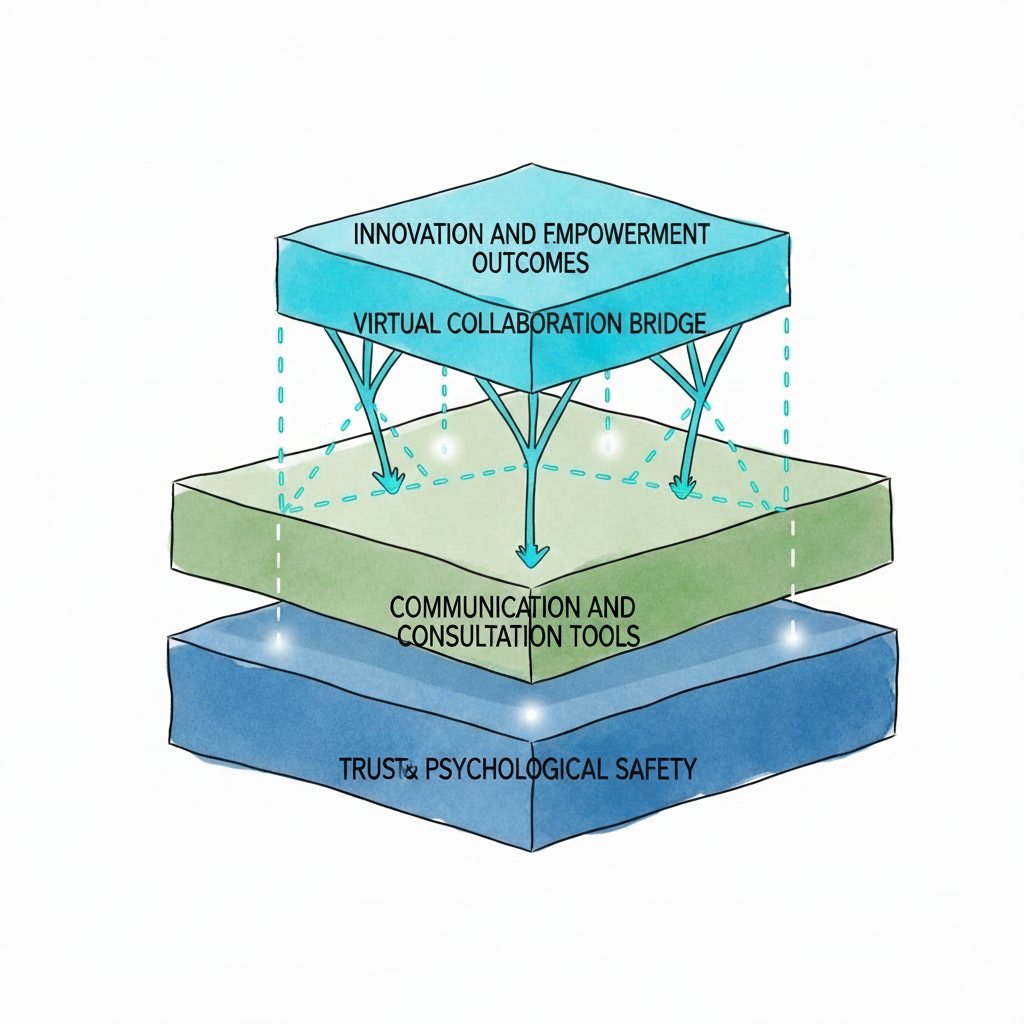
Decision-making had to work across time zones and cultures. With teams spread across continents, I couldn't make quick calls in a hallway. Instead, I created decision templates that captured not just what was decided, but the context, alternatives considered, and reasoning behind the choice. This "consultation trail" turned out to be invaluable -- my Southeast Asian team could review the reasoning and push back asynchronously in writing, which was more comfortable for them than challenging me live. And we learned to use time zones as an advantage: one team would analyze user feedback overnight so the next team started their day with insights ready to act on.
Empowerment required different boundaries for different cultural contexts. My European team thrived with broad autonomy and minimal check-ins -- they wanted room to debate and decide. My Southeast Asian team initially needed tighter guardrails and more frequent calibration, not because they were less capable, but because their professional culture valued different signals about what "ownership" looked like. I defined explicitly what decisions each team should make autonomously, what required consultation, and what needed approval -- and I updated those boundaries as people grew. The one-on-ones I held weren't performance reviews; they were calibration sessions focused on whether people felt supported and autonomous enough.
The Distributed Advantage
The constraints of distance forced me to build leadership systems I never would have developed in a co-located environment. I had to make implicit expectations explicit, document reasoning that would normally live in hallway conversations, and design different approaches for different people instead of assuming one style would work for everyone. Those are just good leadership practices, but proximity lets you get away without them. Distance doesn't.
Within six months, the intentional systems I'd been forced to create were producing better results than any in-person team I'd managed. The distance didn't weaken the teams -- it made the leadership better.