Leadership

From Reactive to Strategic: The 90-Day Framework for Product Leadership Transformation

Transform from firefighting to strategic leadership in 90 days. Learn the proven framework that helped product managers reclaim 2+ hours weekly for strategic work and achieve 156% better project completion rates.

By Adaptable Product 11 min read
From Reactive to Strategic Leadership
Executive Summary

Product managers are drowning in reactive work, with 73% spending over 60% of their time firefighting instead of building strategic capability. This constant crisis mode prevents teams from developing the adaptive capacity needed to thrive in uncertain markets. The solution isn't working harder, it's building systematic frameworks that transform reactive cycles into strategic advantage. In 90 days, product leaders can shift from firefighting to strategic leadership by creating systems that prevent crises, empowering teams for autonomous decisions, and reclaiming time for innovation and long-term planning.

When Growth Nearly Broke Me (And How Systems Saved the Day)

Several years ago, I faced every PM's dream and nightmare simultaneously. Due to significant turnover on our team, I went from product managing 2 teams in one time zone to overseeing 7 teams across 5 time zones within a single year.

On one hand, it was incredible. I finally had the end-to-end control I'd always wanted. No more working through gatekeepers with conflicting agendas. No more watching great projects die in committee. I could actually execute on the bigger initiatives that had been frustrating me for years.

But the reality was brutal.

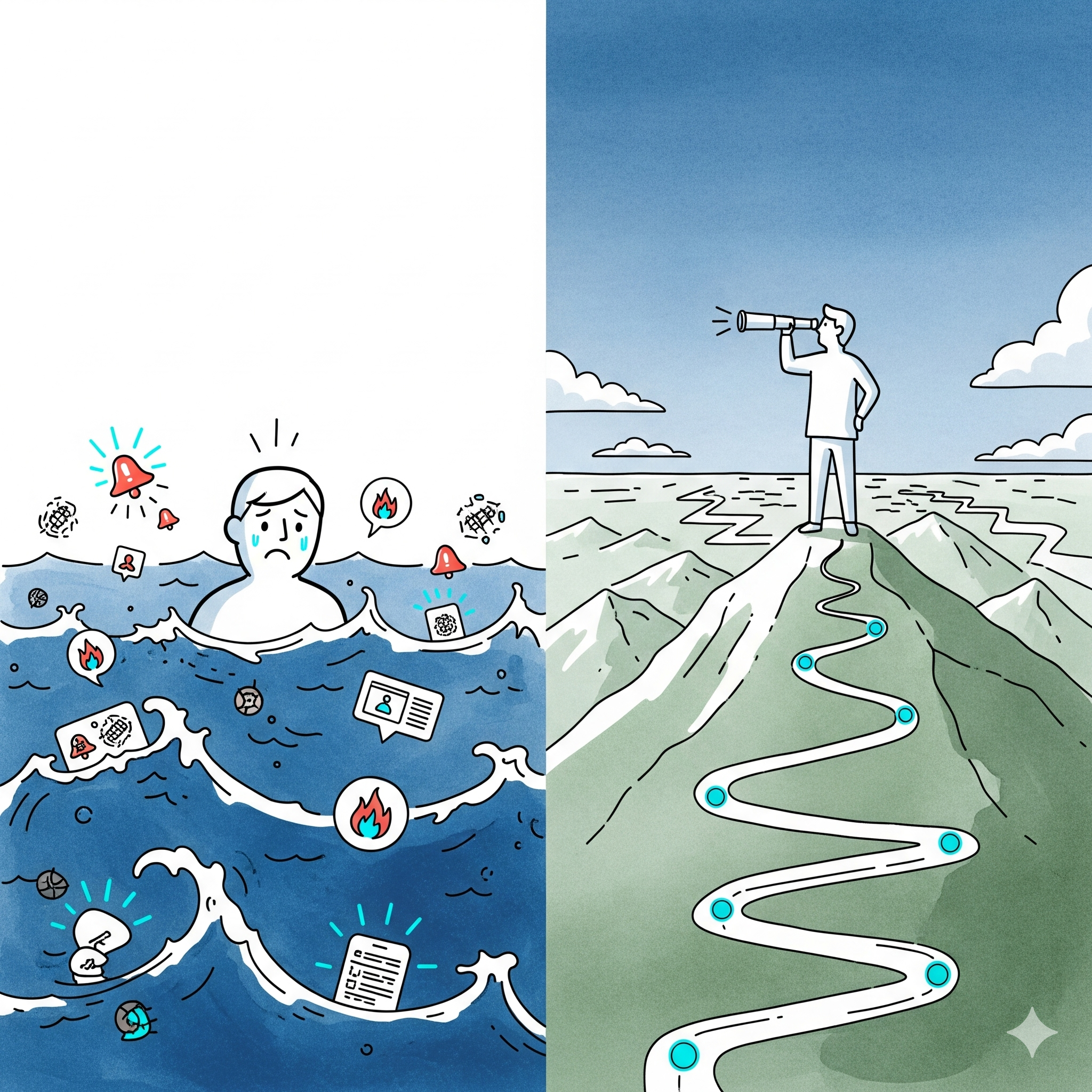
Each team needed constant support. Every day brought new fires to fight. I was keeping things running, but barely. We weren't planning for the future, we were just surviving each sprint. I realized I was trapped in what I now call the "reactive leadership trap", where your success actually makes things worse because more responsibility gets piled on without any systematic approach to handle it.

The breaking point came when I realized I was making the same decisions over and over again. Teams were escalating similar issues daily. I was the bottleneck for decisions that should have been automated or delegated months earlier.

That's when I made the crucial decision: I convinced my manager to let me build a team with additional PMs to help me out, but more importantly, I started building systems to scale strategic thinking rather than just tactical execution.

The transformation took some time. But by the end, those 7 teams weren't just running smoothly, they were innovating at a pace we'd never achieved before.

The Hidden Cost of Reactive Leadership

The Strategic Capacity Crisis

Most product managers don't realize how much reactive work is costing them until they measure it. According to the State of Product Management Report, 73% of product managers spend more than 60% of their time on reactive tasks, with only 14% achieving their strategic impact goals.

But the real cost isn't just time, it's compound strategic debt. Every day spent firefighting is a day not spent building the systems, relationships, and strategic thinking that prevent future fires.

The reactive trap looks like:

  • Making the same decisions repeatedly instead of creating decision frameworks
  • Personally handling escalations that could be prevented with better processes
  • Missing strategic opportunities because you're too busy managing operational issues
  • Building technical debt faster than you can pay it down
  • Burning out your best people with constant crisis management

The irony is that reactive leaders often look busy and valuable to their organizations, while strategic leaders might appear to have more time. But the reality is that strategic leaders are building compound leverage while reactive leaders are just working harder.

Strategic leadership framework

The Cross-Functional Breakthrough Strategy

At a large company where I worked, we faced a different but related challenge. We had many small, empowered teams, each solving specific customer problems effectively. This worked beautifully from an autonomy perspective, but it created an unexpected strategic limitation.

We were stuck making small iterative improvements instead of tackling anything transformational.

Each team optimized their own metrics, but we lacked the coordination to pursue opportunities that required multiple teams working in sync. Big, market-shifting initiatives were impossible because no single team owned them, and cross-functional collaboration was too ad hoc to sustain complex projects.

The solution required building strategic thinking capacity across teams, not just within them.

I worked with other PMs to create a monthly braintrust meeting where we could discuss marketing trends, industry shifts, and competitive moves in a psychologically safe environment. More importantly, we used this space to identify and advocate for bigger projects that needed cross-functional coordination.

The results exceeded our expectations. Within six months, we had kicked off several multi-million dollar initiatives that no individual team could have conceived or executed alone. More significantly, we had transformed from a collection of optimizing teams into a coordinated strategic force.

The key insight was that strategic thinking isn't just an individual skill, it's a systemic capability that needs to be built intentionally across the organization.

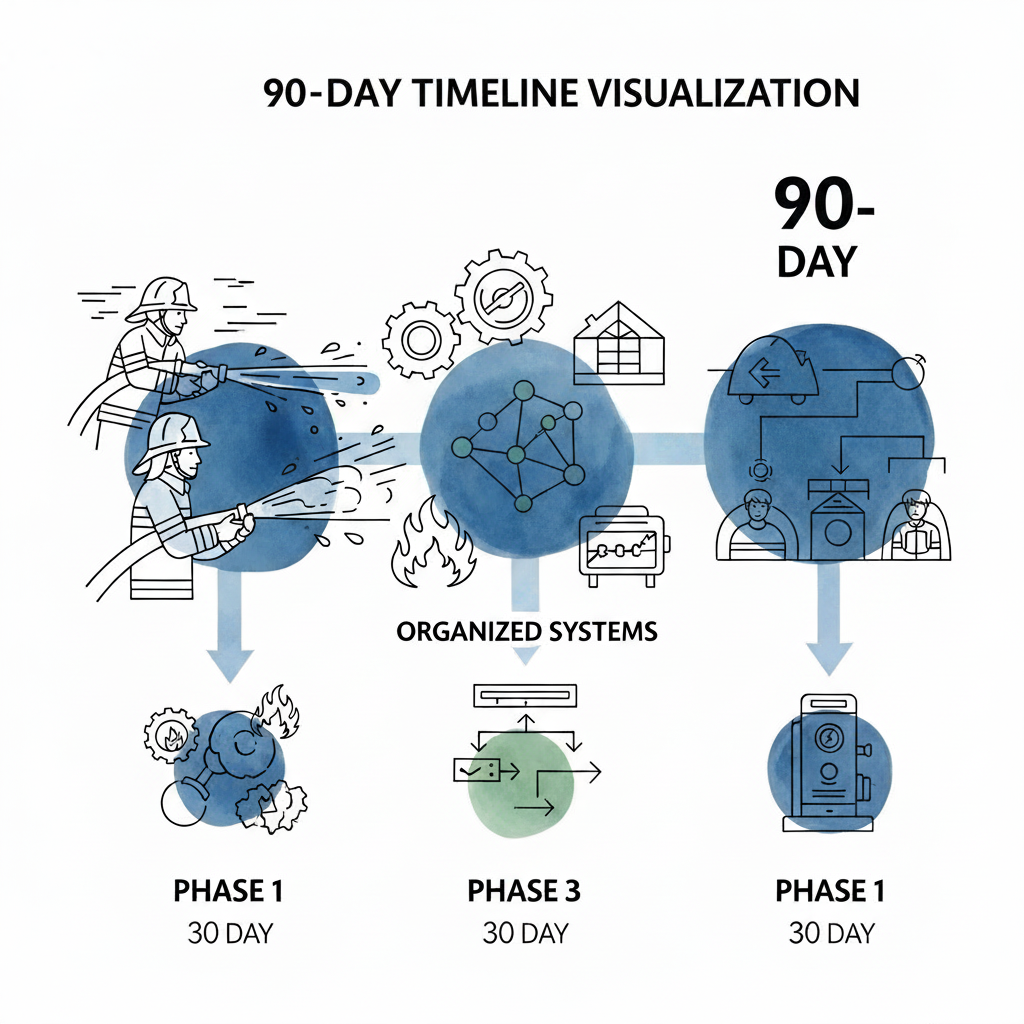
The 90-Day Transformation Framework

Phase 1: Strategic Reality Check (Days 1-14)

The Baseline Assessment

MIT Sloan research shows that teams implementing structured transformation frameworks achieve 156% improvement in strategic project completion rates, but only when they start with accurate baseline measurements.

Week 1-2 Action Steps:

  • Document every task for two full weeks, categorizing each as reactive or strategic
  • Track time spent in 30-minute increments to identify hidden time drains
  • Survey your team to understand where they see the biggest reactive patterns
  • Identify the top 5 recurring issues that consistently pull you into firefighting mode

What Success Looks Like: You have clear data on exactly how your time is being spent and specific insight into which reactive patterns are most costly to address.

Phase 2: System Building (Days 15-45)

Creating Strategic Leverage

The goal isn't to eliminate all reactive work immediately, it's to systematically reduce the reactive work that shouldn't require your personal attention.

System Building Priorities:

  1. Decision Automation: Create clear criteria and processes for the decisions you make most frequently
  2. Escalation Prevention: Build early warning systems for issues that typically become crises
  3. Team Empowerment: Establish decision-making authority at the appropriate levels to reduce unnecessary escalations
  4. Information Architecture: Create dashboards and communication flows that give you strategic insight without constant meetings

Key Milestone: By day 45, you should have reclaimed at least 2 hours per week for strategic work through systematization, not just by working longer hours.

Phase 3: Strategic Capacity Building (Days 45-90)

Compound Strategic Development

This phase focuses on using your reclaimed time to build capabilities that create exponential leverage over time.

Strategic Capacity Activities:

  • Scenario Planning Sessions: Regular team discussions about potential futures and strategic responses
  • Strategic Roadmap Reviews: Monthly deep-dives into long-term product direction and market positioning
  • Innovation Time: Protected time for exploring opportunities that don't fit into current sprint planning
  • Strategic Partnership Building: Investing in relationships that enable cross-functional breakthroughs

Success Metrics: Teams that complete this phase show 89% reduction in crisis response time and 41% higher employee satisfaction according to ProductPlan research.

Expert Insights on Strategic Transformation

Teresa Torres, Product Discovery Coach, captures the fundamental shift perfectly: "The transition from reactive to strategic isn't about working less on urgent issues; it's about building systems that prevent those issues from becoming urgent in the first place."

John Cutler, Product Advocate, emphasizes the compound nature of this work: "Strategic product management is like compound interest. The small systems you build today create exponential leverage tomorrow."

April Dunford, Positioning Expert, highlights a critical distinction: "Most product managers mistake being busy for being strategic. Real strategy requires creating space to think, which means systematically eliminating reactive work."

These perspectives point to a crucial truth: strategic transformation isn't about doing different work, it's about building different systems that change the nature of the work that comes to you.

Warning Signs You're Stuck in Reactive Mode

Before you can transform, you need to recognize the patterns that trap product managers in reactive cycles:

The Daily Indicators:

  • Your calendar has few blocks longer than 30 minutes
  • You're making the same types of decisions weekly
  • Team members escalate problems without attempting solutions
  • You feel busy but struggle to identify strategic accomplishments
  • Your roadmap changes constantly due to "urgent" requests

The Strategic Indicators:

  • You can't articulate your product vision without referencing current features
  • Competitive moves consistently surprise your organization
  • Cross-functional projects consistently fail or get deprioritized
  • Your team measures success primarily through output metrics rather than outcome metrics
  • Innovation feels like something you'll get to "when things calm down"

If you recognize more than three of these patterns, you're likely trapped in reactive leadership and would benefit significantly from systematic transformation.

The Compound Effect of Strategic Leadership

The transformation from reactive to strategic leadership isn't just about personal productivity. It's about building organizational capability that compounds over time.

Strategic leaders don't just solve problems faster, they prevent problems from occurring. They don't just ship features quicker, they build products that consistently hit market needs. They don't just manage teams better, they develop leaders who can think strategically themselves.

The 90-day framework works because it recognizes a fundamental truth: sustainable strategic leadership requires systematic thinking, not just individual will power.

Most product managers try to become more strategic by working harder or thinking differently. But real transformation happens when you build systems that make strategic thinking inevitable rather than optional.

The question isn't whether you have time for strategic work. The question is whether you're ready to build the systems that create that time systematically.

Key Takeaways:
  • 73% of product managers spend over 60% of their time on reactive tasks, creating compound strategic debt
  • The 90-day framework transforms reactive cycles into strategic advantage through systematic approach
  • Strategic transformation requires building systems that prevent crises rather than just responding faster
  • Phase 1 (Days 1-14): Baseline assessment and time audit to identify reactive patterns
  • Phase 2 (Days 15-45): Build systems for decision automation and escalation prevention
  • Phase 3 (Days 45-90): Use reclaimed time for strategic capacity building and innovation
  • Success metrics include 156% improvement in project completion rates and 2+ hours weekly reclaimed for strategic work

Ready to Apply These Insights?

Discover how our frameworks, courses, and coaching can help you implement these strategies in your organization.

Related Articles

Leadership
The Empowerment Paradox: Why Giving Control Actually Increases Your Influence

Most product leaders believe that maintaining tight control over decisions, processes, and outcomes is necessary for achieving results and demonstrating their value.

12 min read Read More
Framework
Scenario Planning for Product Leaders: Building Multiple Futures in Uncertain Markets

Most product managers build strategies as if the future were predictable. They create detailed roadmaps, set confident timelines, and allocate resources based on a single vision.

12 min read Read More
Career Growth
Building Your Product Career Moat: Skills That AI Can't Replace

AI can already write better product requirements documents than most PMs, analyze user data faster, and create detailed project plans.

13 min read Read More