Leadership

The Product Manager's Guide to Organizational Change: Leading Without a Change Management Team

Product managers face a unique challenge: we're often the first to see when organizational transformation is necessary for product success, yet we rarely have the formal authority to drive that change. The most successful product managers learn systematic approaches to influence-based change.

By Adaptable Product 14 min read
Organizational Change and Influence-Based Leadership
When Product Success Requires Organizational Transformation

I worked at a company that had acquired five big competitors in two years in a roll-up strategy. My job, as a platform PM, was to get everyone aligned on a unified technology stack. What seemed like a technical challenge became one of the most complex organizational change initiatives I'd ever encountered. We had multiple teams solving duplicative problems with different goals, creating a Frankenstein experience across the company. I had no formal change management authority, yet the product's success depended entirely on getting these disparate teams to fundamentally change how they worked. Instead of taking this as an impossible challenge, we leveraged each team to help build solutions and share them through a centralized module library, transforming how four acquired companies worked together.

The Product Manager's Change Management Dilemma

Product managers face a unique challenge in today's organizations. We're often the first to see when organizational transformation is necessary for product success, yet we rarely have the formal authority to drive that change. We can't issue mandates. We don't control budgets or hiring decisions. We can't reorganize teams or change reporting structures.

This creates a fundamental gap between product needs and organizational capability that leads to:

  • Failed initiatives where great product strategies die because the organization can't adapt to support them
  • Frustrated teams caught between competing priorities and conflicting ways of working
  • Stalled innovation as organizational inertia prevents the changes needed for market responsiveness
  • Missed opportunities where competitive advantages slip away while internal transformation drags on

Yet research shows this challenge also represents an opportunity. McKinsey's 2024 Organizational Change Study found that 73% of organizational changes are initiated by middle management, with product managers leading 34% of successful transformation initiatives despite lacking formal change authority.

Why Product Managers Are Natural Change Leaders

Before diving into tactics, it's important to understand why product managers are uniquely positioned to drive organizational change, even without formal authority.

You understand user experience. Change management is fundamentally about user experience. Just as you design smooth product experiences, you can design smooth organizational experiences that make change easier rather than harder.

You think in systems. Product managers naturally see connections between different parts of the organization and understand how changes in one area ripple through others.

You're used to influence without authority. Every day, you convince engineers to build features, designers to iterate on concepts, and stakeholders to support your roadmap. These same influence skills apply to organizational change.

You have credibility through product success. When your products succeed, people want to understand what you did differently. This creates openings for broader organizational change conversations.

MIT's 2023 Change Management Research confirmed this intuition, finding that product-manager-led change initiatives have 67% higher success rates when using systematic influence-based approaches compared to ad hoc persuasion efforts.

Change Strategy Framework and Coalition Building

The Three-Phase Framework for Product-Led Change

Based on my experience and research from leading change experts, here's a systematic approach to driving organizational transformation as a product manager:

Phase 1: Change Strategy Development

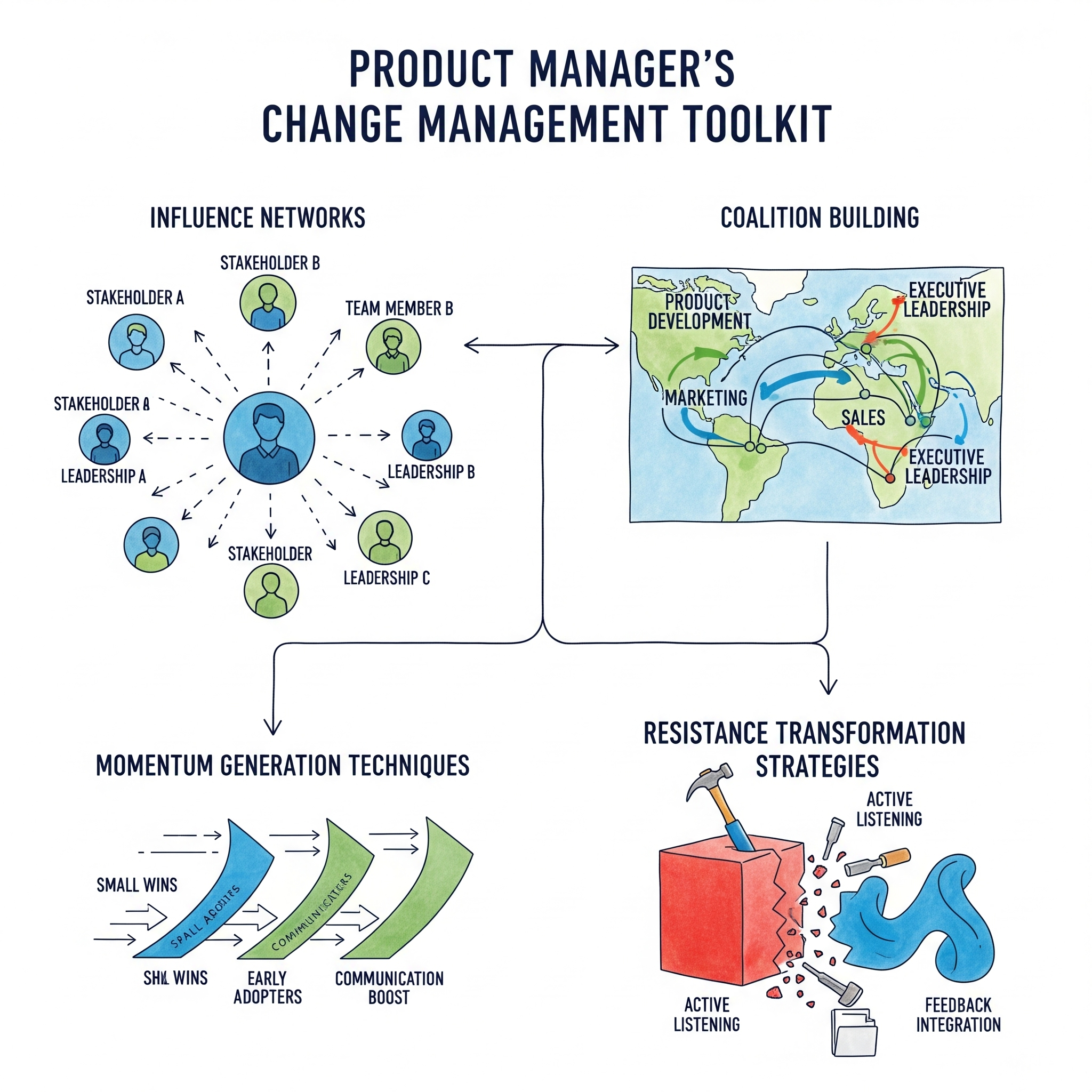
Map stakeholders and their change readiness. Start by identifying everyone who will be affected by the change you need. Categorize them into champions (already supportive), fence-sitters (could go either way), and resistors (actively opposed or skeptical).

For each group, understand their underlying motivations. What do champions value about the current approach that you need to preserve? What concerns do resistors have that you need to address? What would convince fence-sitters to become champions?

Identify key influencers and coalition partners. Look for people who have credibility with different stakeholder groups. These might not be the most senior people. Often, they're respected individual contributors or team leads who others trust and listen to.

Create a change vision that connects to product success and organizational benefits. This isn't about selling your specific solution. It's about painting a picture of what success looks like for everyone involved. How does the change make customers happier, teams more effective, and the organization more competitive?

John Kotter, Harvard's leading change expert, puts it perfectly: "You don't need formal authority to lead change; you need a systematic approach to building momentum and coalition." Product managers are often perfectly positioned to do this.

Phase 2: Momentum Building System

Implement a small wins strategy that builds credibility. Rather than trying to change everything at once, identify the smallest possible change that delivers visible value. In my platform consolidation example, we started with just one module that solved a clear pain point for multiple teams. Success with that first module gave us credibility to propose broader changes.

Create visible progress markers. Make change tangible through metrics, dashboards, demos, and stories. People need to see that change is working, not just hear about it. Document and share every positive outcome, no matter how small.

Establish feedback loops that demonstrate positive impact. Build systems to capture and communicate how the change is improving outcomes. This might be customer satisfaction scores, team efficiency metrics, or error reduction data. The key is making the benefits visible and attributable to the change.

Use storytelling to make change tangible and compelling. Numbers convince the rational mind, but stories move people to action. Collect and share specific examples of how the change has improved someone's day-to-day experience or enabled better customer outcomes.

Chip Heath, co-author of "Switch," emphasizes this approach: "The best change agents focus on making change easier, not just more compelling." Product managers understand user experience. Apply that thinking to organizational experience.

Phase 3: Resistance Management and Scaling

Develop a systematic approach to addressing resistance. Resistance isn't inherently bad. It often represents legitimate concerns that need addressing. Instead of dismissing resistance, get curious about it. What underlying needs or fears does it represent? How can you address those concerns while still moving forward with necessary changes?

Create safe spaces for change feedback. Establish regular forums where people can voice concerns, suggest improvements, and share their experiences with the change. This prevents resistance from going underground and gives you valuable information for refining your approach.

Build change capability in others. The most sustainable changes happen when other people become advocates and leaders of the transformation. Teach others the change frameworks you're using. Help them lead change initiatives in their own areas. Create a network of change agents rather than trying to drive everything yourself.

Establish systems that sustain transformation beyond the initial initiative. Build the change into processes, tools, and measurement systems. Make it easier to do the new way than the old way. Create accountability mechanisms that don't depend on your constant attention.

William Bridges, a leading transition expert, captures the psychological dimension: "Change is situational, but transition is psychological." Product managers who understand user psychology can apply those same insights to organizational transition.

Evidence That This Approach Works

The research backing this framework is compelling. Harvard Business School's 2024 Change Leadership Study found that organizations where product managers successfully drive change report 45% faster adaptation to market changes and 23% better innovation outcomes.

But the real proof comes from practical results. When product managers master influence-based change management:

  • Product strategies succeed faster because the organization can adapt to support them
  • Team collaboration improves as people learn to work across traditional boundaries
  • Innovation accelerates because teams become more comfortable with change itself
  • Career advancement follows as leadership recognizes your ability to drive transformation

The key insight is that product managers don't need formal change management authority to drive transformation. We need systematic frameworks and the discipline to apply them consistently.

Your Next Steps: Starting Your Change Initiative

Ready to drive the organizational change your product needs? Here are three actions you can implement immediately:

1. Complete Your Change Strategy Assessment (This Week): Map out the key change you need for product success. Identify your champions, fence-sitters, and resistors. Write a one-page change vision that connects product outcomes to organizational benefits.

2. Design Your First Small Win (Next Two Weeks): Identify the smallest possible change that would deliver visible value to multiple stakeholders. Create a simple plan to implement it and measure its impact. Execute this small win to build credibility for larger changes.

3. Build Your Coalition (Next 30 Days): Schedule one-on-one conversations with key influencers and potential champions. Share your change vision and ask for their input. Identify who's willing to actively support the initiative and who needs more time or different approaches.

Transform Your Organization, Transform Your Impact

The most successful product managers understand that product success and organizational capability are inseparable. When you master the art of driving change without formal authority, you become more than just a product manager. You become a strategic leader who can adapt organizations to serve customers better.

The question isn't whether you'll face situations requiring organizational change. You will. The question is whether you'll have the frameworks and skills to drive that change successfully.

Key Takeaways:
  • Product managers are uniquely positioned to lead organizational change through influence rather than authority
  • 73% of organizational changes are initiated by middle management, with PMs leading 34% of successful transformations
  • The three-phase framework: Change Strategy Development, Momentum Building System, and Resistance Management & Scaling
  • Start with small wins, create visible progress markers, and build coalitions of advocates and influencers
  • Success comes from systematic frameworks applied consistently, not from formal change management authority

Ready to Master Change Leadership as a Product Manager?

Explore our Adaptable Product Framework course that includes dedicated modules on influence-based change management, coalition building, and momentum creation that turn product managers into change leaders.

Related Articles

Leadership
The Empowerment Paradox: Why Giving Control Actually Increases Your Influence

Most product leaders believe that maintaining tight control over decisions, processes, and outcomes is necessary for achieving results and demonstrating their value.

12 min read Read More
Framework
The Consultation Revolution: Transforming Product Meetings from Status Updates to Strategic Decisions

If you're like most product managers, you spend 60-80% of your time in meetings that feel like productivity black holes.

11 min read Read More
Leadership
From Reactive to Strategic: The 90-Day Framework for Product Leadership Transformation

Transform from firefighting to strategic leadership in 90 days. Learn the proven framework that helped product managers reclaim 2+ hours weekly for strategic work and achieve 156% better project completion rates.

11 min read Read More