Innovation

The Hidden Innovation Hiding in Your Organization: How to Discover and Embrace Radical Voices

Discover how 68% of breakthrough innovations come from non-leadership roles. Learn systematic frameworks to identify, amplify, and act on insights from organizational edges before competitors do.

By Adaptable Product 13 min read
Hidden Innovation in Organizations
Executive Summary

The most valuable product insights often hide in plain sight at the edges of organizations among customer service teams, junior engineers, and new hires. Yet traditional corporate structures systematically suppress these voices, creating dangerous innovation blind spots. MIT research shows that 68% of breakthrough product innovations originate from employees in non-leadership roles, with customer-facing teams generating 34% more actionable insights than executive strategy sessions. The solution isn't hiring more innovative people but building systematic frameworks to identify, amplify, and act on radical ideas before competitors discover the same opportunities.

My First Boss Taught Me Everything About Innovation (By Accident)

One of my first bosses in product management was actually a customer service manager who had an unusual realization: he was spending more time acting like a product manager than managing customer service. Instead of staying in his lane, he convinced leadership to let him create a new product team and hire actual PMs.

I had just graduated from business school and became his first PM hire. He was excited about bringing in business school frameworks and technology insights to build proper PM processes and tools. But what shaped me more than any MBA course was his perspective from working directly with customers and sales teams every day.

He showed me something that executive strategy sessions never could: the real, messy, unfiltered voice of customers struggling with our products in the field.

To this day, whenever I start a new PM role, I spend my first day sitting with customer service agents and salespeople. Then I reach out directly to key customers to understand how they actually use our products. This immediate action accomplishes three critical things:

  1. Trust Building: It creates instant credibility and communication channels with key stakeholders who often feel ignored by product teams
  2. Radical Voice Discovery: It helps me identify the edge thinkers who I can return to when I need outside-the-box thinking
  3. Ground Truth: It gives me an unvarnished picture of product performance from the front lines, not filtered through management layers

That customer service manager turned boss taught me that innovation doesn't come from the top down. It comes from the edges where your organization meets the real world.

The $Multi-Million Idea That Almost Got Ignored

A few years later, I experienced firsthand how easily breakthrough innovations get missed when organizations don't systematically listen to their edges.

I was working with a technical architect who was always thinking about the big, complex problems in our systems. He had been hearing persistent concerns about the limitations of our unstructured data and the lack of identified relationships. He understood that properly structuring this data would unlock tremendous capabilities in chatbots, AI, and reporting.

So he started prototyping taxonomy solutions in his spare time, just for fun.

When he showed me his demo, I was genuinely impressed. The tool was elegant and addressed real problems I'd been hearing from customers. Unfortunately, we had no budget or resources allocated for this kind of infrastructure work. I told him I was glad he'd shared the demo and encouraged him to keep exploring the solution, even though we couldn't move forward immediately.

Then opportunity knocked in an unexpected way.

Later that year, our company acquired a rival, and we suddenly had a cross-organizational integration project with real resources and budget. The obvious solution was to dump their data into our existing system because it was fastest and cheapest. But this approach would have exacerbated all our existing data structure problems.

I remembered the architect's taxonomy solution and asked him to demo it to the integration team. Both teams immediately saw the potential. Instead of taking the easy path, we decided to build a new system that incorporated the best pieces from both platforms while adding the taxonomy layer that would benefit everyone.

The project was a massive success, ultimately generating millions in additional revenue through improved AI capabilities, newfound efficiencies, and system cost savings.

But here's the crucial insight: this innovation would have been completely missed if I hadn't built a relationship with that architect and created space for him to share his "crazy" ideas. The breakthrough was hiding in our organization the entire time, waiting for someone to listen and act.

Why Organizations Systematically Miss Their Best Ideas

The Innovation Hierarchy Problem

Traditional corporate structures create what we can call "innovation hierarchy bias" where ideas are valued based on the seniority of their source rather than their potential impact. This happens because:

  • Executives assume they have the best strategic perspective (but often lack ground-level customer insight)
  • Middle managers filter ideas to match what they think leadership wants to hear
  • Edge voices lack formal channels to reach decision-makers without multiple approvals
  • Radical ideas get dismissed as impractical without proper evaluation frameworks

Harvard Business School research confirms this pattern: organizations with systematic edge-voice amplification processes achieve 45% faster innovation cycles and identify market opportunities 78% sooner than competitors who rely primarily on top-down innovation processes.

The Edge Advantage

Stanford Design School research shows that companies implementing structured "radical voice" programs report 23% higher employee engagement and 67% improvement in product-customer fit metrics. This happens because edge voices offer three unique advantages:

  1. Fresh Perspective: New hires and junior employees haven't been conditioned by "that's how we've always done it" thinking
  2. Direct Customer Contact: Customer-facing teams hear unfiltered feedback that gets sanitized by the time it reaches executive summaries
  3. Cross-Functional Insight: People working across departmental boundaries see opportunities that specialists miss
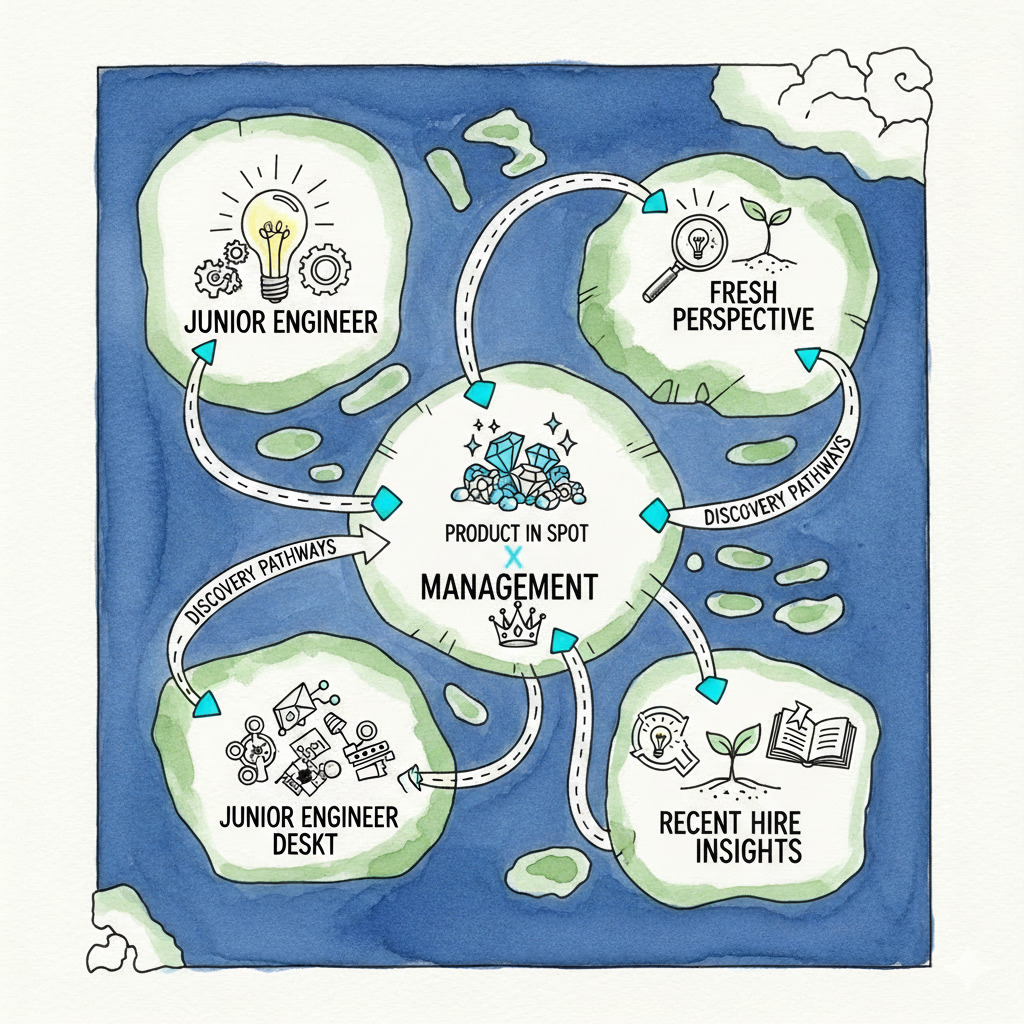
Innovation framework diagram

The Three-Layer Framework for Capturing Hidden Innovation

Layer 1: Edge Voice Mapping

Identify Your Innovation Sources

The first step is systematically mapping where innovation insights are most likely to originate in your organization:

  • Customer-Facing Roles: Sales, customer service, technical support, customer success
  • Recent Hires: Anyone with less than 18 months at the company who brings outside perspective
  • Cross-Functional Team Members: People who work across departmental boundaries and see connection opportunities
  • Technical Specialists: Engineers, designers, and analysts who understand capability possibilities

Create Monthly Listening Sessions

Once you've mapped these sources, establish regular touchpoints where edge voices can share unfiltered insights without management interpretation. The key is creating psychological safety where people can share ideas that might seem impractical or challenging to current approaches.

Layer 2: Radical Idea Pipeline

Structured Evaluation for Unconventional Ideas

Create a formal process that gives unconventional ideas a fair evaluation rather than default dismissal. This includes:

  • Anonymous Submission Options: Remove hierarchy bias by allowing ideas to be evaluated on merit alone
  • Long-Term Potential Criteria: Evaluate ideas based on strategic potential, not just immediate feasibility
  • Rapid Prototype Funding: Provide small budgets for promising concepts to demonstrate viability
  • Cross-Functional Review Teams: Include diverse perspectives in idea evaluation to avoid groupthink

Layer 3: Edge Voice Amplification

Direct Access to Decision-Makers

Implement quarterly presentations where non-traditional sources present directly to product leadership. This system should include:

  • Required Follow-Up Actions: Leadership must respond to insights with specific next steps or explanations
  • Public Recognition: Celebrate insights that drive product improvements to encourage continued participation
  • Implementation Tracking: Monitor which edge insights actually influence product decisions and outcomes

Expert Perspectives on Organizational Innovation

Clay Christensen, innovation expert, identified this pattern decades ago: "The most disruptive insights come from the intersection of fresh eyes and direct customer contact. That rarely happens in the C-suite."

Tina Seelig from Stanford Innovation Director emphasizes the systematic nature required: "Innovation happens at the edges where different worlds collide. The key is building systems that capture those collisions before they dissipate."

Rita McGrath from Columbia Business School connects this to competitive advantage: "Competitive advantage increasingly comes from seeing what others miss. And what others miss is usually hiding in plain sight at the edges of their own organizations."

These perspectives highlight a critical truth: organizations that systematically harness edge insights don't just innovate faster, they innovate in directions competitors can't see.

Warning Signs You're Missing Edge Innovation

Organizational Red Flags:

  • Ideas consistently come from the same small group of senior leaders
  • Customer feedback gets filtered through multiple management layers before reaching product teams
  • New hires stop offering suggestions after their first few months
  • Cross-functional collaboration happens only during formal project kickoffs
  • Innovation initiatives focus primarily on external research rather than internal insights

Cultural Red Flags:

  • People say "that's not how we do things here" more often than "let's explore that"
  • Junior employees rarely speak up in strategy meetings
  • Customer service insights are treated as complaints rather than innovation opportunities
  • Technical specialists are excluded from strategic planning discussions
  • Ideas need extensive validation before getting any resources for exploration

If you recognize these patterns, your organization is likely missing significant innovation opportunities that competitors might discover first.

Actionable Takeaways: Start Discovering Hidden Innovation This Month

Week 1: Map Your Edge Innovation Sources

Identify 10-15 people in customer-facing roles, recent hires, and cross-functional positions. Schedule 30-minute conversations to understand their perspectives on customer needs and product opportunities. Focus on listening rather than defending current approaches.

Week 2: Create Your First Radical Idea Collection Process

Set up a simple system (shared document, suggestion box, or brief survey) where people can submit unconventional ideas anonymously. Include questions about customer pain points they observe and capabilities they wish existed.

Week 3-4: Launch Monthly Edge Voice Sessions

Schedule regular touchpoints with your mapped edge voices where they can share insights without formal presentations or management filters. Make these conversations about exploration and possibility rather than immediate implementation.

The Compound Effect of Systematic Edge Listening

Building systematic processes to discover and act on edge insights isn't just about finding individual breakthrough ideas. It's about developing organizational capability to see opportunities that competitors miss consistently.

When you create reliable channels for radical voices, several compound effects emerge:

Cultural Transformation: People throughout the organization start thinking more innovatively when they know their ideas will be heard and evaluated fairly.

Customer Insight Acceleration: Direct customer feedback reaches decision-makers faster and with higher fidelity, improving product-market fit continuously.

Competitive Advantage: Your organization develops the ability to spot emerging opportunities months or years before they become obvious to competitors.

Employee Engagement: People feel more invested in outcomes when they see their insights driving real product improvements.

The question isn't whether your organization has hidden innovation waiting to be discovered. The question is whether you're building the systematic processes to find and act on it before your competitors do.

Key Takeaways:
  • 68% of breakthrough innovations originate from employees in non-leadership roles
  • Customer-facing teams generate 34% more actionable insights than executive strategy sessions
  • Organizations with edge-voice amplification achieve 45% faster innovation cycles
  • The three-layer framework: Edge Voice Mapping, Radical Idea Pipeline, and Voice Amplification
  • Innovation hierarchy bias values ideas by source seniority rather than potential impact
  • Structured "radical voice" programs improve employee engagement by 23%
  • Systematic edge listening creates compound effects: cultural transformation, customer insight acceleration, and competitive advantage

Ready to Apply These Insights?

Discover how our frameworks, courses, and coaching can help you implement these strategies in your organization.

Related Articles

Innovation
Building a Learning Community: Leveraging Collective Intelligence for Innovation

I took over a data science team building advanced scoring models for content assessment. We were on the 7th iteration of our regression model, which had actually decreased its ability to correctly score documents.

12 min read Read More
Innovation
Healthy Constraints: How Smart Limitations Actually Unlock Innovation

I ran a product that let business owners manage and respond to reviews from customers about their offerings. When I explored ways to bring more insight and usefulness from our review data through sentiment analysis, we had no budget, no data science team availability.

8 min read Read More
Innovation
Product Communities: How Internal Networks Drive Innovation

While most organizations invest heavily in external user communities, they completely neglect internal product communities, creating costly silos and missed innovation opportunities.

15 min read Read More