When Questioning Everything Leads to Strategic Breakthrough
I joined a company building a new user experience with three interfaces for image uploads and moderation. The roadmap was packed, engineering estimates were intimidating, and everyone seemed resigned to building three complex systems. Instead of accepting requirements at face value, I started asking uncomfortable questions: "Do we actually need human moderation at all?" "Are we sure partners and internal users need different interfaces?" These weren't popular questions, but they led to discoveries that transformed our entire approach. We went from three interfaces down to one, delivered faster with fewer resources, and created a better user experience than the original plan would have provided. The breakthrough insight? The most powerful strategic tool wasn't in any framework—it was the willingness to ask questions that made everyone uncomfortable.
Why Product Managers Avoid the Hard Questions
Most product managers are skilled at asking tactical questions: "How should we prioritize this feature?" "What does the user research tell us?" "How can we improve conversion rates?" These questions are important, but they operate within existing assumptions about what we're building and why.
The questions we avoid are the existential ones: "Should this product exist at all?" "Are we solving the right problem?" "What if our entire market understanding is wrong?" We avoid these questions because:
They're uncomfortable. Existential questions challenge the foundation of our work. They might reveal that months of effort were based on false assumptions or that our product strategy has fundamental flaws.
They feel unproductive. Tactical questions lead to clear action items. Existential questions can lead to uncertainty, debate, and sometimes complete strategy pivots that feel like starting over.
They threaten stakeholder relationships. When you question fundamental assumptions, you're implicitly suggesting that people who made those assumptions might have been wrong. This can feel threatening to leadership and cross-functional partners.
They reveal difficult truths. Sometimes existential questions uncover problems that are expensive or politically challenging to address. It's easier to keep building than to confront the reality that we might need to stop.
But this avoidance creates strategic blind spots that can be fatal to product success. MIT's 2024 Strategic Thinking Research found that teams that regularly challenge fundamental assumptions identify strategic risks 78% earlier and discover breakthrough opportunities 56% more frequently than teams focused only on tactical questions.
The Hidden Cost of Assumption Comfort
When we avoid existential questions, we operate within invisible constraints that limit our strategic thinking and blind us to both risks and opportunities.
We perpetuate failing approaches. Without questioning fundamental assumptions, teams continue investing in products, features, or market strategies long after they've stopped working. The sunk cost fallacy becomes institutionalized.
We miss breakthrough opportunities. The biggest product innovations often come from questioning assumptions that everyone else accepts as truth. When we don't ask those questions, we miss the insights that could transform our market position.
We create strategic brittleness. Products built on unexamined assumptions are fragile. When market conditions change or competitive dynamics shift, they have no foundation for adaptation because the underlying strategic thinking was never stress-tested.
We limit team potential. Teams that don't grapple with hard questions develop tactical skills but miss opportunities to build strategic thinking capabilities that could accelerate their careers and impact.
Harvard Business School's 2023 Strategy Study confirms this pattern: product managers who implement systematic assumption challenging report 67% improvement in strategic clarity and 45% better long-term market positioning.
The Power of Strategic Discomfort
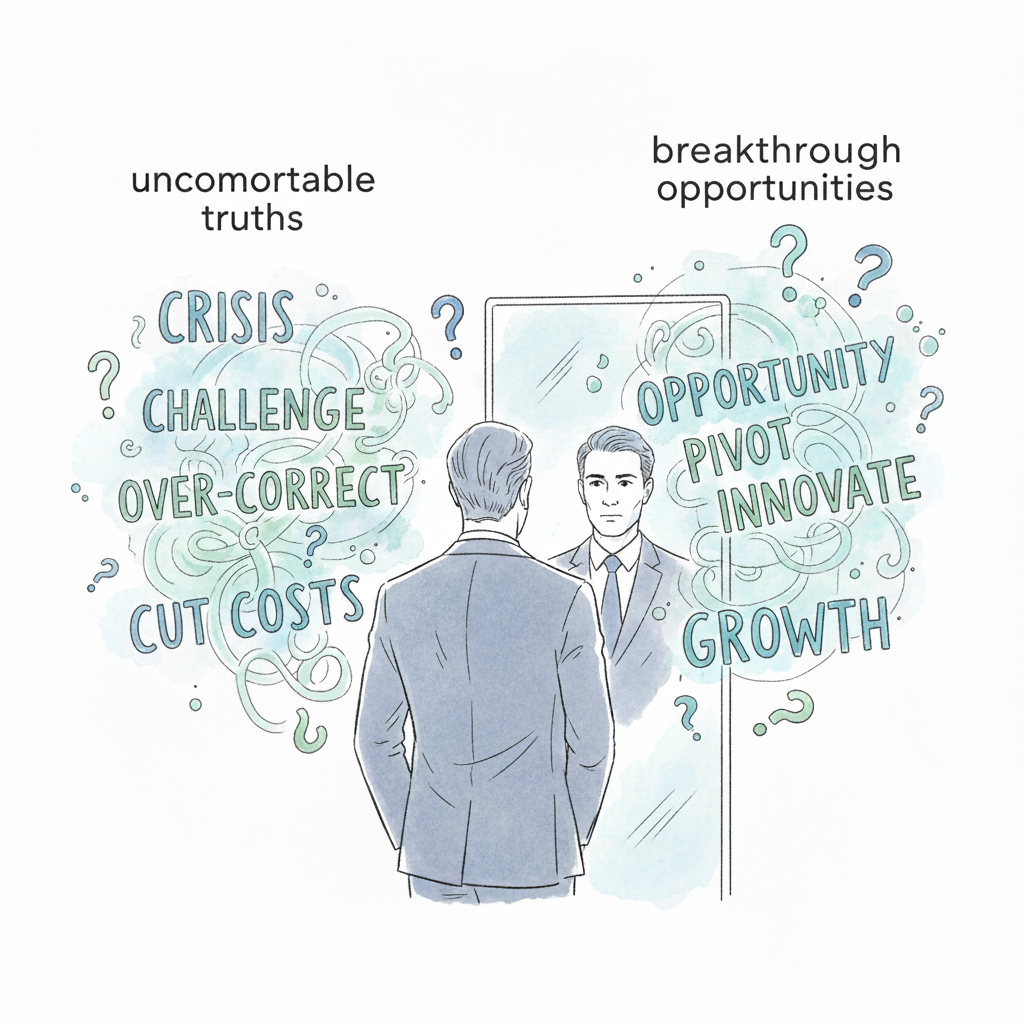
The most successful product managers understand that discomfort is a strategic asset, not something to be avoided. When questions make us uncomfortable, they're often pointing toward the assumptions that most need examination.
Discomfort signals hidden assumptions. The questions that feel threatening or unproductive often reveal beliefs we've never articulated or examined. These hidden assumptions shape our decisions in ways we don't recognize.
Uncertainty creates strategic options. When we question fundamental assumptions, we often discover that we have more strategic choices than we realized. What seemed like constraints might actually be changeable variables.
Hard questions reveal competitive advantages. The assumptions that everyone in your industry accepts without question often represent the biggest opportunities for differentiation. When you're willing to challenge what others won't, you can discover unique market positions.
Peter Thiel, author of "Zero to One," captures this perfectly: "The most important questions are the ones nobody is asking. What important truth do very few people agree with you on? That's where breakthrough products are born."
The Three-Framework System for Existential Questions
Based on research from leading strategy experts and my own experience, here's a systematic approach to asking the hard questions that transform product strategy:
Framework 1: Existential Question Development
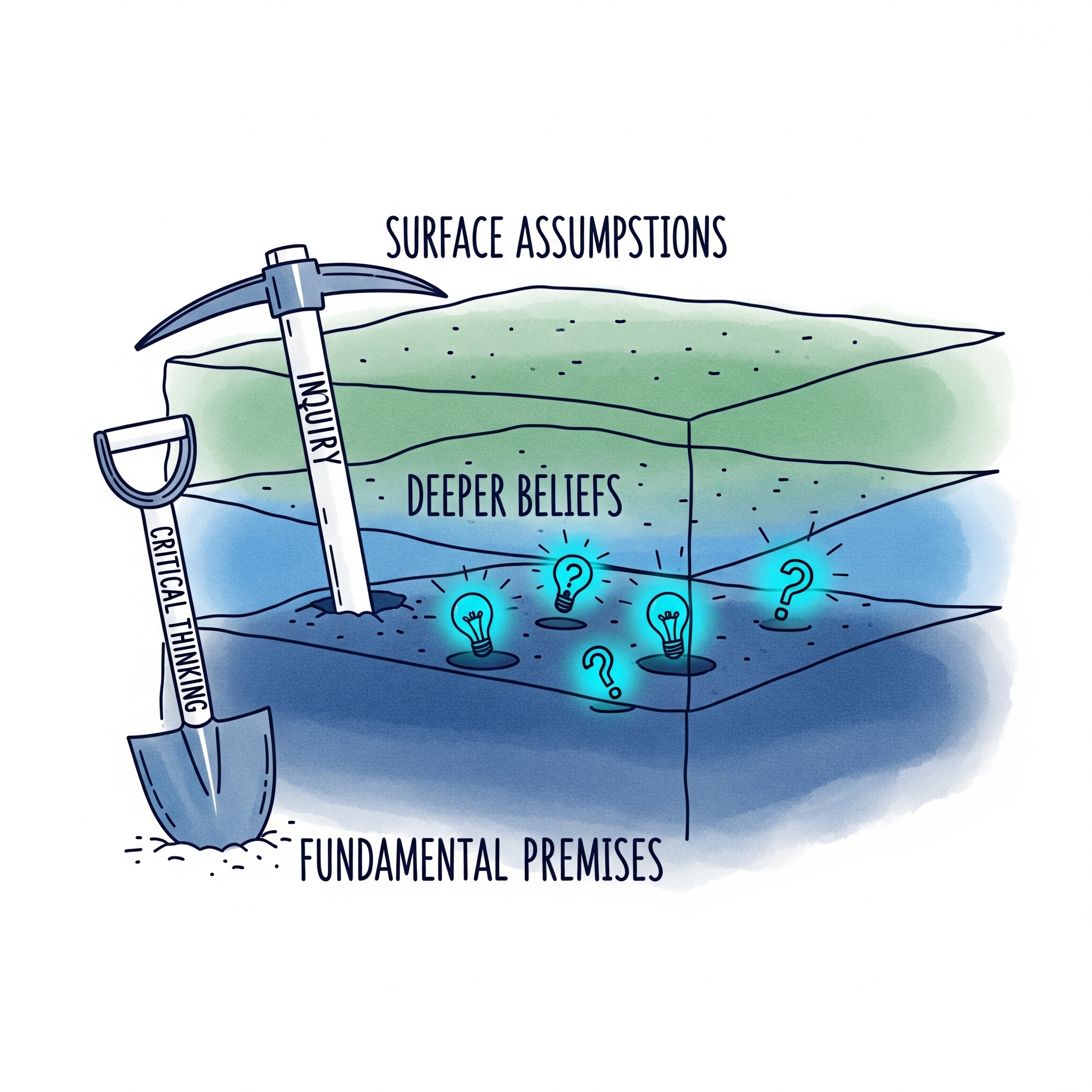
Challenge product purpose systematically. Start with the most fundamental question: "Should this product exist at all?" Then drill deeper: "What problem are we really solving?" "Who benefits most from this solution?" "What would happen if we stopped building this tomorrow?"
Create structured questioning sessions where the goal isn't to defend current strategy but to examine it objectively. Use techniques like "five whys" and "what if" scenarios to surface underlying assumptions about value, market need, and competitive positioning.
Examine market assumptions ruthlessly. Question beliefs about market size, customer behavior, competitive dynamics, and industry trends. Ask: "What if this market is smaller than we think?" "What if customer behavior is changing in ways we haven't recognized?" "What if our competition comes from unexpected directions?"
Test customer value propositions rigorously. Challenge assumptions about what customers actually value and why they choose your product. Ask: "What if customers use our product for reasons we don't understand?" "What if the value we think we provide isn't the value they actually receive?" "What if there's a simpler solution to their problem?"
Clayton Christensen, the innovation expert, emphasized this approach: "The questions that make you most uncomfortable are usually the ones you most need to ask. They reveal the assumptions that might be undermining your strategy."
Framework 2: Assumption Audit Process
Conduct quarterly assumption deep-dives. Schedule regular sessions dedicated entirely to examining fundamental assumptions about product, market, customers, and competition. Make these separate from tactical planning sessions to create space for strategic thinking.
Create assumption maps that document what you believe to be true about your market, customers, competition, and product value. Then systematically examine the evidence for each assumption and identify which ones are most critical to your strategy's success.
Use structured assumption testing techniques. Implement approaches like assumption reversal ("What if the opposite were true?"), scenario planning ("How would our strategy perform under different conditions?"), and pre-mortem analysis ("If our product failed, what assumptions would likely have been wrong?").
Create safe spaces for uncomfortable discussions. Establish team norms that make it safe to question fundamental assumptions without being seen as negative or disloyal. Frame assumption challenging as a risk management and opportunity identification activity, not criticism of current strategy.
Framework 3: Strategic Reality Testing
Build ongoing assumption validation systems. Create regular processes for testing strategic assumptions against market reality. This might include customer interview programs specifically focused on assumption validation, competitive intelligence gathering, or market research designed to challenge rather than confirm existing beliefs.
Establish early warning systems for assumption failures. Develop metrics and signals that would indicate if key assumptions are becoming invalid. Create dashboards that track not just product performance but assumption health.
Cultivate team comfort with strategic uncertainty. Help your team understand that assumption evolution is a sign of learning, not failure. Create processes for updating strategy based on new information without treating it as a setback.
Rita McGrath, the strategy expert, captures this mindset: "Strategic blindness comes from not questioning what seems obviously true." The best product managers systematically challenge their own certainties.
Evidence for the Existential Approach
The research supporting systematic assumption challenging is compelling. Stanford's 2024 Strategic Decision Making Research found that organizations with structured existential questioning processes avoid 34% more strategic failures and achieve 23% better product-market fit outcomes.
But the real proof comes from practical results. When product managers master the art of asking hard questions:
- Strategic clarity improves as teams develop clearer understanding of what they're building and why
- Risk identification accelerates as hidden assumptions surface before they can cause strategic failures
- Breakthrough opportunities emerge as teams discover market positions and value propositions that competitors miss
- Team strategic capability builds as people develop skills for thinking beyond tactical execution
The key insight is that the questions that make us most uncomfortable often point toward the insights that could transform our strategic position.
Your Next Steps: Starting Your Existential Practice
Ready to harness the power of strategic discomfort? Here are three actions you can implement immediately:
1. Conduct Your First Assumption Audit (This Week): List the five most fundamental assumptions underlying your current product strategy. For each assumption, write down what evidence supports it and what evidence might contradict it. Identify which assumptions are most critical and least validated.
2. Design Your Existential Question Session (Next Two Weeks): Schedule a dedicated session with your team focused entirely on challenging fundamental assumptions. Prepare specific existential questions about product purpose, market understanding, and customer value. Create ground rules that make it safe to question everything.
3. Build Ongoing Reality Testing (Next 30 Days): Establish one regular process for validating key assumptions against market reality. This might be monthly assumption-focused customer interviews, quarterly competitive intelligence reviews, or ongoing metric tracking that measures assumption health, not just product performance.
Transform Discomfort Into Strategic Advantage
The most successful product managers understand that strategic thinking isn't about having all the answers. It's about having the courage to ask the questions that others won't. When you develop systematic approaches to challenging fundamental assumptions, you don't just improve your current strategy. You build the capability to adapt and innovate in ways that create lasting competitive advantages.
The question isn't whether you're smart enough to build successful products based on your current assumptions. You probably are. The question is whether you're brave enough to challenge those assumptions before your competition does.
Key Takeaways:
- Teams that regularly challenge fundamental assumptions identify strategic risks 78% earlier and discover breakthrough opportunities 56% more often
- Existential questions reveal hidden assumptions and strategic blind spots that tactical questions miss
- The three frameworks: Existential Question Development, Assumption Audit Process, and Strategic Reality Testing
- Discomfort signals the assumptions that most need examination and often point toward competitive advantages
- Start with assumption audits, create safe questioning spaces, and build ongoing reality testing systems immediately