Innovation

Building Your Learning Community: From Solo Practitioner to Collective Intelligence

Most product managers operate as solo practitioners, but this individualistic approach creates significant blind spots. Learning communities represent a fundamental shift from individual expertise to collective intelligence, solving problems 67% faster and generating 89% more innovative solutions.

By Adaptable Product 12 min read
Learning Communities and Collective Intelligence
When Fresh Perspectives Unlock Breakthrough Solutions

I took over a data science team building advanced scoring models for content assessment. We were on the 7th iteration of our regression model, which had actually decreased its ability to correctly score documents. A new data analyst with interest in neural networks offered to work on this on the side. His different approach using document embeddings instead of just metadata increased our scoring effectiveness by 30%. The breakthrough didn't come from the expert who had been working on the problem for years—it came from someone with fresh eyes, different experience, and enthusiasm for exploring new approaches. This taught me that the most powerful problem-solving asset isn't individual expertise. It's collective intelligence.

The Isolation Trap That Limits Product Managers

Most product managers operate as solo practitioners. We take pride in our individual expertise, our ability to synthesize complex information, and our capacity to make tough decisions independently. But this individualistic approach creates significant blind spots and missed opportunities:

We duplicate problem-solving efforts. How many product managers in your organization are struggling with the same prioritization challenges, stakeholder alignment issues, or technical trade-offs? Instead of sharing insights and solutions, we each reinvent the wheel in isolation.

We fail to leverage diverse perspectives. Every product manager brings unique experience and viewpoints. When we work in silos, we miss opportunities to apply insights from different domains, markets, or technical backgrounds to our current challenges.

We create knowledge gaps. When product managers leave the organization, their hard-won insights leave with them. Without systematic knowledge sharing, organizations lose valuable learning and have to rebuild expertise from scratch.

We limit breakthrough thinking. The most innovative solutions often emerge from combining different perspectives and approaches. Solo practitioners miss the creative sparks that happen when diverse minds collaborate on complex problems.

MIT's 2024 Collective Learning Research confirms what many of us have experienced: organizations with active learning communities solve complex problems 67% faster and generate 89% more innovative solutions compared to individual problem-solving approaches.

Why Learning Communities Transform Product Management

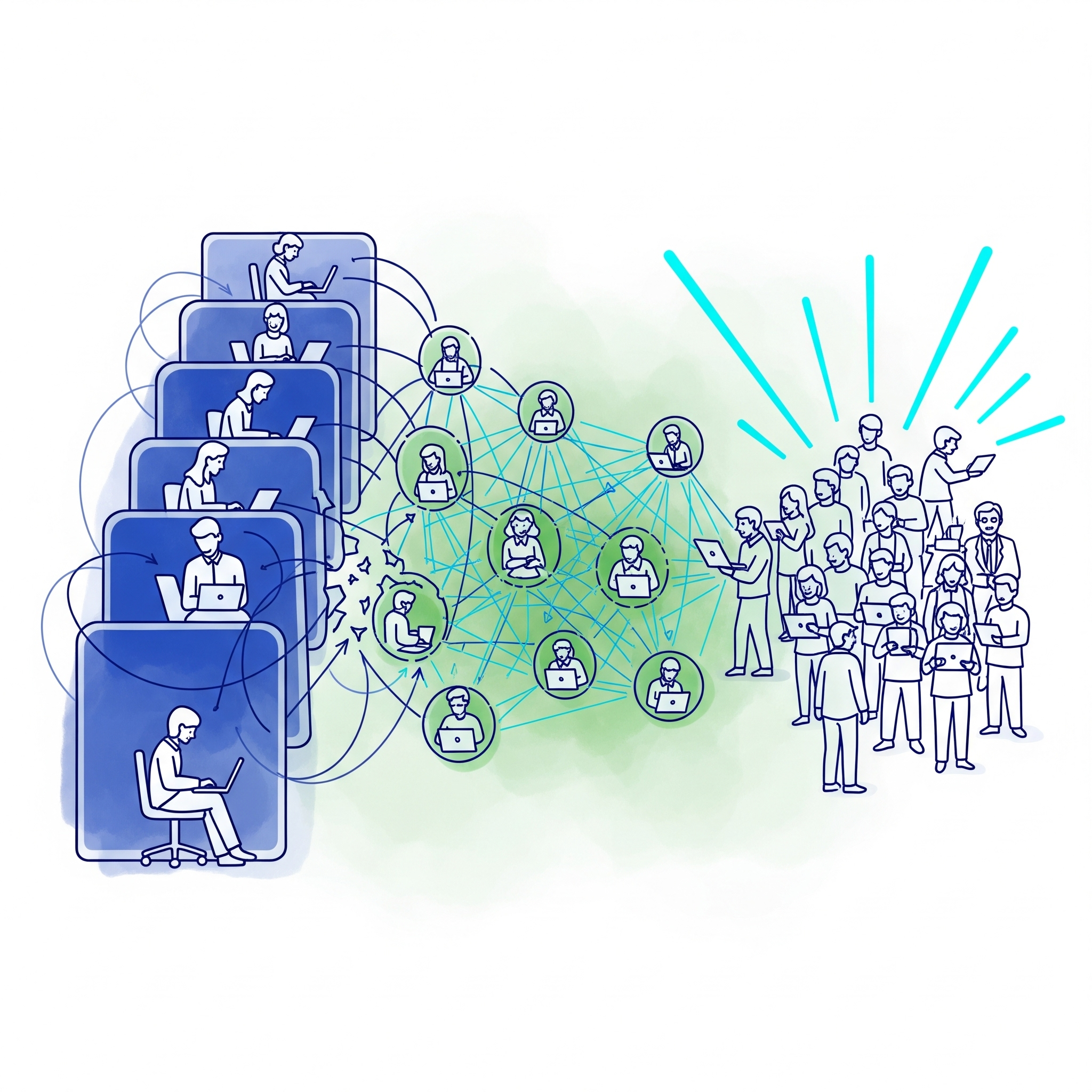
Learning communities represent a fundamental shift from individual expertise to collective intelligence. Instead of being the smartest person in the room, you become part of the smartest group in the organization.

Accelerated problem-solving. When you're stuck on a challenge, instead of struggling alone, you can tap into the collective experience of peers who have likely faced similar issues. Problems that might take weeks to resolve individually can be solved in days through collaborative insight.

Enhanced decision-making quality. Better decisions emerge when you can test your thinking against diverse perspectives, identify blind spots you wouldn't see alone, and incorporate insights from different contexts and experiences.

Organizational knowledge retention. Learning communities create systems where insights and best practices persist beyond individual tenure. When someone leaves, their knowledge stays within the community rather than walking out the door.

Innovation through cross-pollination. The most breakthrough product ideas often come from applying solutions from one domain to challenges in another. Learning communities facilitate these connections naturally.

Peter Senge, the renowned expert on learning organizations, puts it perfectly: "The real competitive advantage comes from learning faster than your competition. Learning communities accelerate that process exponentially."

Learning Community Framework and Knowledge Sharing Systems

The Three-Pillar Framework for Building Learning Communities

Based on research from leading organizations and my own experience, here's a systematic approach to creating thriving learning communities:

Pillar 1: Community Design and Launch

Identify potential community members and their learning needs. Start by mapping out product managers and adjacent roles who would benefit from collaborative learning. This might include product owners, technical product managers, growth PMs, and even designers or engineers who work closely with product decisions.

Conduct informal interviews to understand what challenges people are facing, what knowledge they'd love to access, and what expertise they could contribute to others. Look for natural affinities and complementary skill sets.

Design community structure with clear purpose and engagement mechanisms. Successful learning communities need more than good intentions. They need clear structure and compelling reasons for people to participate regularly.

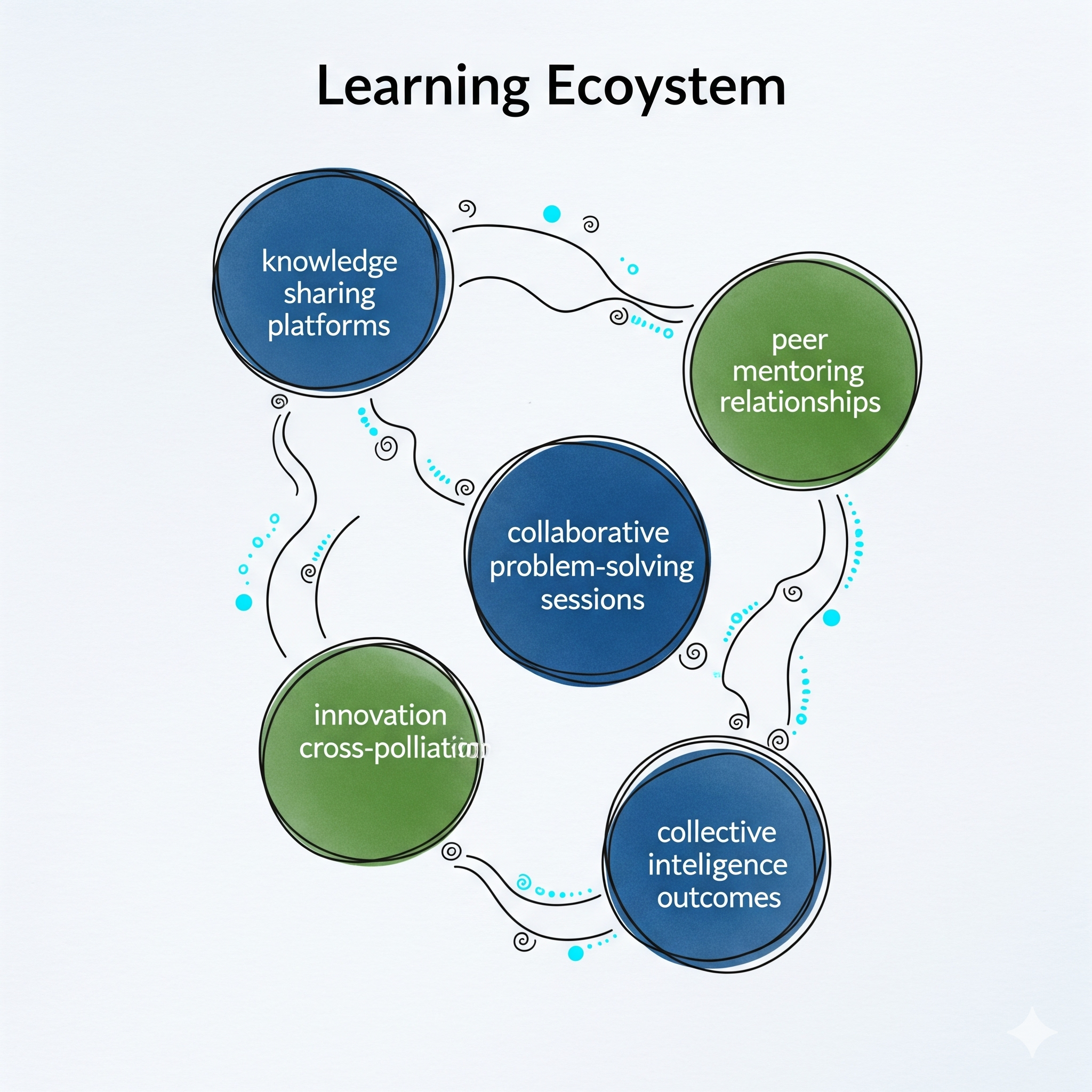
Define the community's core purpose. Are you focused on skill development, problem-solving, innovation, or knowledge sharing? Create regular engagement mechanisms like monthly problem-solving sessions, peer mentoring pairs, or collaborative project reviews.

Launch with high-value initial activities that demonstrate immediate benefit. The first few community interactions determine whether people continue participating. Design launch activities that solve real problems and create immediate value for participants.

This might be a collaborative session tackling a current challenge someone is facing, a knowledge-sharing session where experienced PMs share battle-tested frameworks, or a cross-functional innovation workshop that generates actionable ideas.

Pillar 2: Knowledge Sharing Systems

Create platforms and processes for sharing insights, lessons learned, and best practices. Learning communities need systematic ways to capture and distribute knowledge. This doesn't require complex technology, but it does require consistent processes.

Establish regular formats for sharing insights: weekly lightning talks, monthly case study presentations, or quarterly retrospectives on major initiatives. Create repositories for frameworks, templates, and lessons learned that community members can access and contribute to.

Implement peer mentoring programs. Formal mentoring relationships create deep learning opportunities and strengthen community bonds. Pair experienced product managers with newer team members, but also create reverse mentoring where junior PMs share fresh perspectives with senior colleagues.

Establish regular collaborative problem-solving sessions. Schedule recurring sessions where community members can bring current challenges for group problem-solving. These sessions generate immediate value while building collaborative thinking skills and strengthening relationships.

Etienne Wenger, the pioneer of communities of practice research, emphasizes this point: "Knowledge lives in communities, not in individuals." Product managers who tap into collective intelligence make better decisions and build better products.

Pillar 3: Collective Intelligence Cultivation

Develop group decision-making processes that harness diverse perspectives. Create structured approaches for involving community members in complex decisions. This might include decision-making frameworks that incorporate multiple viewpoints, systematic bias checks, or collaborative evaluation processes.

The goal isn't consensus on every decision, but rather ensuring that important decisions benefit from collective intelligence before individual product managers make final calls.

Create innovation cross-pollination between different product areas. Design activities that help community members learn from each other's domains. This might be regular "product showcases" where teams share interesting approaches, cross-functional hackathons, or structured idea exchange sessions.

Measure and communicate community impact to sustain engagement and organizational support. Learning communities need to demonstrate value to maintain momentum and organizational backing. Track metrics like problem resolution time, knowledge sharing frequency, innovation project outcomes, and member satisfaction.

Share success stories that show how community collaboration led to better product outcomes, faster problem-solving, or innovative solutions that wouldn't have emerged through individual work.

Amy Edmondson, Harvard's leading expert on team learning, captures the psychological dimension: "Learning communities create psychological safety for experimentation and knowledge sharing. That's where breakthrough insights happen."

The Evidence for Collective Intelligence

The research supporting learning communities in product management is compelling. Harvard Business School's 2023 Knowledge Management Study found that companies with systematic peer learning programs report 45% improvement in product manager capability development and 78% better knowledge retention during employee transitions.

Stanford Education Research from 2024 showed that learning communities increase individual performance by 34% while building organizational capability that persists 67% longer than individual training approaches.

But the real evidence comes from practical results. Organizations with thriving product management learning communities consistently demonstrate:

  • Faster problem resolution as teams leverage collective experience instead of starting from scratch
  • Higher innovation rates through cross-pollination of ideas and approaches
  • Better retention of institutional knowledge that persists beyond individual tenure
  • Stronger product manager capabilities as people learn from diverse experiences and perspectives
  • More effective collaboration across teams and functions

Your Next Steps: Starting Your Learning Community

Ready to transform from solo practitioner to collective intelligence leader? Here are three actions you can implement immediately:

1. Map Your Learning Network (This Week): Identify 5-8 product managers or adjacent roles who would benefit from collaborative learning. Schedule informal conversations to understand their challenges, expertise, and interest in community learning. Look for natural partnerships and complementary skills.

2. Design Your First Community Session (Next Two Weeks): Plan a single, high-value session that brings potential community members together around a real challenge or learning opportunity. This might be a collaborative problem-solving session, a framework-sharing workshop, or a cross-team innovation brainstorm. Focus on creating immediate value and positive experience.

3. Establish Regular Knowledge Sharing (Next 30 Days): Create a simple, sustainable system for ongoing knowledge sharing. This might be weekly peer mentoring pairs, monthly problem-solving sessions, or quarterly retrospective and planning meetings. Start small but be consistent.

Transform Individual Excellence Into Collective Advantage

The most successful product managers understand that individual expertise has limits, but collective intelligence has exponential potential. When you build learning communities, you don't just accelerate your own growth. You create systems that make everyone smarter, faster, and more innovative.

The question isn't whether you're smart enough to solve complex product challenges alone. You probably are. The question is whether you're wise enough to harness the collective intelligence that could solve them better, faster, and more creatively than individual effort ever could.

Key Takeaways:
  • Learning communities solve complex problems 67% faster and generate 89% more innovative solutions than individual approaches
  • The isolation trap limits breakthrough thinking by duplicating efforts and missing diverse perspectives
  • The three pillars: Community Design & Launch, Knowledge Sharing Systems, and Collective Intelligence Cultivation
  • Start by mapping your learning network, designing high-value initial sessions, and establishing regular knowledge sharing rhythms
  • Collective intelligence has exponential potential compared to individual expertise limitations

Ready to Build Collective Intelligence Capabilities?

Explore our Adaptable Product Framework course that includes dedicated modules on community building, collective intelligence, and collaborative problem-solving that transform individual capability into organizational advantage.

Related Articles

Innovation
Healthy Constraints: How Smart Limitations Actually Unlock Innovation

I ran a product that let business owners manage and respond to reviews from customers about their offerings. When I explored ways to bring more insight and usefulness from our review data through sentiment analysis, we had no budget, no data science team availability.

8 min read Read More
Leadership
How Product Managers Drive Organizational Change Without Authority

I worked at a company that had acquired five big competitors in two years in a roll-up strategy. My job, as a platform PM, was to get everyone aligned on a unified technology stack.

14 min read Read More
Innovation
The Hidden Innovation Hiding in Your Organization: How to Discover and Embrace Radical Voices

The most valuable product insights often hide in plain sight at the edges of organizations among customer service teams, junior engineers, and new hires.

13 min read Read More