Executive Summary
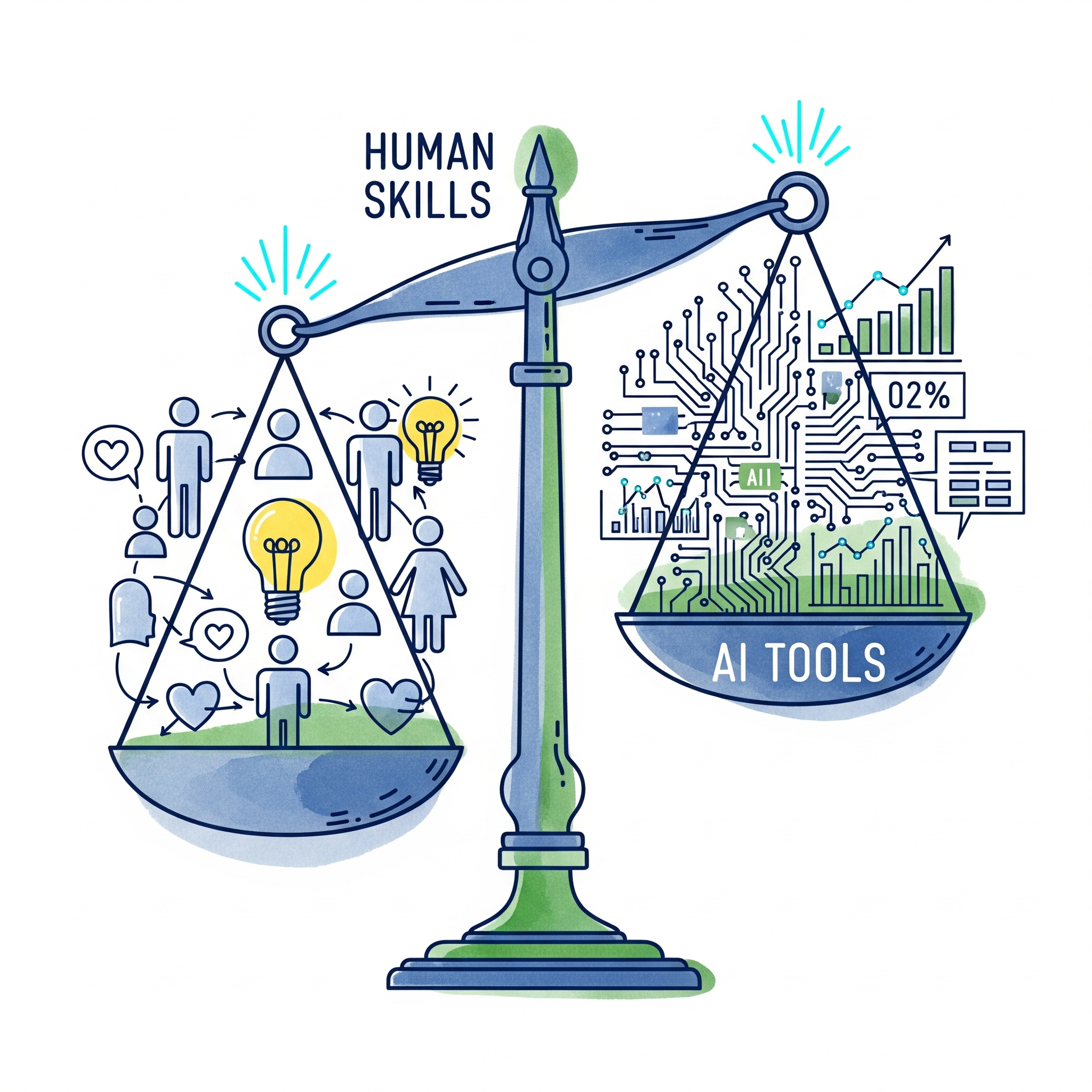
As artificial intelligence transforms product management by automating analysis and forecasting, a counterintuitive truth emerges: the most successful product managers aren't competing with AI but are doubling down on distinctly human capabilities. While AI handles data processing and tactical execution, humans excel at exercising judgment in ambiguous situations, creating genuine team empowerment, and crafting inspiring visions that drive innovation. This shift demands product managers develop stronger human skills, not weaker ones.
When AI Gets the Data Right But You Get the Decision Wrong
I remember being part of a team that had early access to some LLM tools. We were excited about using AI to generate content for physical properties in our marketplace. The technology seemed perfect: fast, consistent, and data-driven. We quickly tested a deployment of it and watched as our content generation improved dramatically in speed and volume.
But then we hit a wall. The AI was producing beautifully formatted, grammatically perfect content that was also completely wrong about key product specifications. Items were being mislabeled, features were being hallucinated, and amenities and services were being invented. We tried adding checks and validations, but the content became as generic as our original basic system had been.
The problem wasn't the AI's capabilities. The problem was our assumption that better data automatically leads to better decisions.
We had forgotten that selling physical products requires human judgment about what details matter to real customers, which features to emphasize for different audiences, and how to balance accuracy with compelling marketing. The AI could process infinite data points, but it couldn't understand the subtle human context that makes content actually useful.
This experience taught me something crucial: as AI becomes more powerful at processing information, human judgment becomes more valuable, not less.
The Hidden Cost of AI Dependency
The Judgment Atrophy Problem
Recently, I worked with a highly ambitious product manager on my team. She was intelligent, driven, and wanted to excel at product management. When she asked for book recommendations, I suggested one of my favorites, a classic that had shaped my thinking over years of real-world application.
The next day, she came back with questions about the book. I was impressed by her speed until I learned she had only read AI-generated summaries and bullet points. While she could recite the frameworks basics, she had missed the deeper insights that come from wrestling with complex ideas, understanding the context behind each lesson, and connecting the concepts to real situations.
We spent the next several weeks reading it together, chapter by chapter. As we discussed each section, she began to understand not just what the frameworks were, but why they worked, when they didn't, and how to adapt them to unique situations. The difference between surface knowledge and deep understanding became clear.
This experience revealed a critical danger: AI can give us information faster than ever, but wisdom still requires human processing time, reflection, and the messy work of applying concepts to real-world complexity.
The Three Pillars of Human-Centric Product Management
1. Judgment Over Automation
McKinsey research shows that AI could automate up to 45% of current product management tasks by 2030, making human judgment three times more valuable as a differentiator. But judgment isn't just about making better decisions, it's about knowing which decisions matter most.
The judgment advantage shows up in:
- Recognizing when AI recommendations miss crucial context
- Balancing quantitative insights with qualitative understanding
- Making tough calls when data points in multiple directions
- Understanding the human implications of technical decisions
2. Empowerment Over Control
Harvard Business Review found that teams led by product managers who balance AI insights with human empowerment show 67% higher innovation rates compared to AI-driven teams. Real empowerment means creating environments where team members can exercise their own judgment, challenge assumptions, and contribute insights that AI cannot generate.
True empowerment involves:
- Teaching teams to question AI outputs constructively
- Creating space for human creativity alongside AI efficiency
- Building decision-making frameworks that include human intuition
- Fostering psychological safety for challenging data-driven conclusions
3. Vision Over Optimization
AI excels at optimizing for known variables, but it struggles with the unknown unknowns that define breakthrough innovation. Gartner research shows that organizations where product leaders focus on vision-setting and community building alongside AI tools achieve 23% faster time-to-market and 31% higher customer satisfaction scores.
Vision-driven leadership means:
- Articulating aspirational outcomes that inspire human action
- Connecting technology capabilities with deep human needs
- Building shared purpose that transcends individual metrics
- Creating narratives that help teams navigate uncertainty
Learning from AI Tool Failures
When I tried using various AI tools to write a Product Requirements Document (PRD), I expected to save time and get comprehensive results. Instead, I discovered the limitations of pure AI-driven product work.
The first attempts were disasters. The AI hallucinated features that didn't exist, made wildly optimistic growth projections without any pushback, and created solutions that sounded impressive but were completely disconnected from our actual technical constraints and market realities.
I learned that AI tools work best when they're part of a collaborative process, not a replacement for human thinking. The breakthrough came when I:
- Started with my own thinking: I outlined my ideas, customer assumptions, and strategic context first
- Used AI as a thinking partner: I prompted it to ask clarifying questions and challenge my assumptions
- Maintained control of the process: I guided the iterative refinement while letting AI help with research and analysis
- Validated everything: I tested AI suggestions against real-world constraints and customer feedback
This approach took longer than I expected, but it produced PRDs that were both comprehensive and actually buildable.
Expert Perspectives on the AI-Human Balance
Marty Cagan from Silicon Valley Product Group captures this perfectly: "The future belongs to product managers who can synthesize AI capabilities with deep human insight. The technology amplifies judgment, it doesn't replace it."
Christina Wodtke, product management expert, adds crucial nuance: "AI gives you data about what happened. Humans give you wisdom about what should happen next. The magic is in combining both."
Gibson Biddle, former VP Product at Netflix, provides strategic context: "Product management has always been about connecting technology possibilities with human needs. AI makes the technology more powerful, but the human connection becomes even more critical."
These insights point to a fundamental truth: the most successful product managers won't be those who use AI the most, but those who use it most thoughtfully while strengthening their distinctly human capabilities.
Actionable Takeaways: Building Your Human Advantage
1. Audit Your Decision Process (Start This Week)
For the next 30 days, track every significant product decision and categorize it as either AI-informed or human-judgment-driven. Look for patterns in which approach leads to better outcomes, faster implementation, and stronger team buy-in.
2. Create Human-AI Collaboration Rituals (Implement in 2 Weeks)
Establish weekly team sessions where you present AI insights first, then facilitate structured human discussions about context, implications, and alternative interpretations. This builds your team's capacity to work with AI rather than be replaced by it.
3. Develop Vision-Crafting Skills (Practice Monthly)
Once a month, practice articulating your product vision without referencing any data points. Focus instead on human needs, emotions, and aspirational outcomes that inspire action. This exercise strengthens your ability to think beyond what AI can analyze.
The Future Belongs to Human-AI Collaborators
The AI revolution in product management isn't coming, it's here. But the winners won't be the teams that rely most heavily on AI tools. They'll be the teams that use AI to amplify human judgment, empowerment, and vision.
As AI handles more tactical work, product managers have an unprecedented opportunity to focus on what humans do best: understanding complex contexts, building genuine relationships, and creating inspiring visions that drive teams toward breakthrough innovation.
The question isn't whether AI will change product management, it's whether you'll use this change to become more human, not less.
Key Takeaways:
- AI automates tactical work, making human judgment more valuable as a differentiator
- Successful product managers use AI as a thinking partner, not a replacement for critical thinking
- The three pillars of human-centric product management: Judgment over Automation, Empowerment over Control, Vision over Optimization
- AI gives you data about what happened; humans provide wisdom about what should happen next
- Start auditing your decision processes and creating human-AI collaboration rituals immediately